


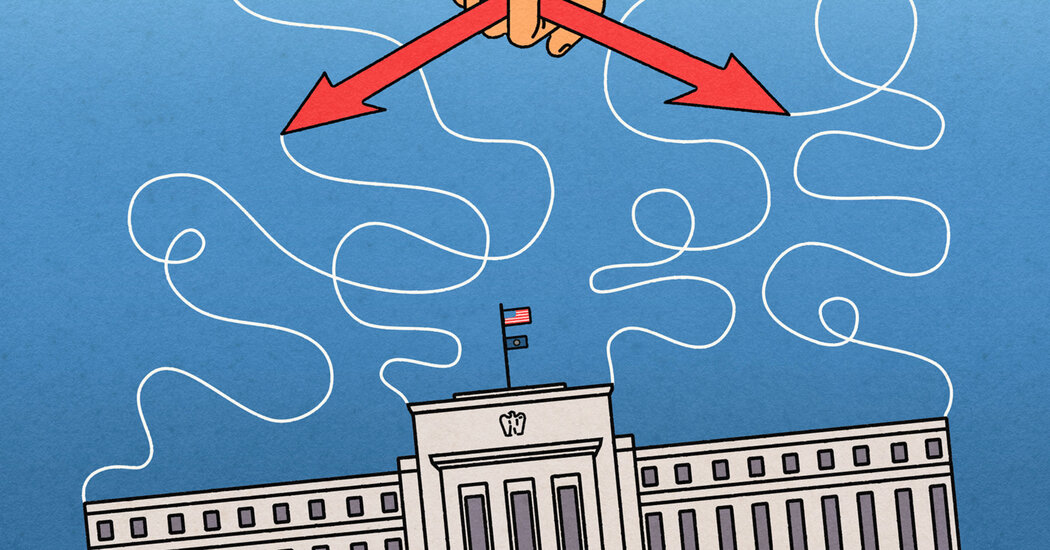
Lower mortgage rates, lower credit card rates, lower business loan rates and more. Anyone who borrows money pays less for it. The economy could boom and markets explode.
President Trump has left no doubt that the Federal Reserve will cut short-term interest rates, which it directly controls, if he has his way. Lower interest rates tend to stimulate the economy and the stock market, a development that is not coincidentally good for incumbent presidents and their political parties.
But the implications of lowering interest rates beyond appropriate levels for the economy are complicated and not entirely positive. In fact, while they may benefit Mr. Trump and the Republican Party, they could lead to higher inflation and ultimately even higher interest rates. Furthermore, any action that undermines the Fed’s credibility could undermine the institution’s ability to respond effectively in a severe financial crisis.
In a telephone conversation, Tim Duy, chief U.S. economist at SGH Macro Advisors, a financial research firm, explained some of the less obvious implications of the current battle between Mr. Trump and Fed leaders, particularly Jerome H. Powell, whose term as chairman expires in May.
The next Fed chair “had to resist pressure from Trump and do the right thing” in setting monetary policy, Duy said. If the Fed gives in to Mr. Trump’s demands for a sharp rate cut even if economic conditions don’t justify it, the economy could hit a “sugar high” in time to boost Republicans’ chances in the 2028 election, Duy said, but there could be long-term damage to the economy. “There is a reason why Federal Reserve independence is an important issue,” he said.
The fight
This battle over the Fed’s future moved to the Supreme Court on Wednesday. The justices heard arguments on the merits of Mr. Trump’s attempt to fire Lisa Cook, a Fed governor since 2022, based on allegations that she was involved in mortgage fraud, which she denies. In an apparent gesture of support for Ms. Cook and opposition to Mr. Trump’s efforts to control the Fed, Mr. Powell attended the court hearing, a rare appearance for a Fed chairman.
The Justice Department issued subpoenas this month as part of a criminal investigation into Mr. Powell. In a videotaped statement, he said the investigation was merely a fabricated “consequence of the Federal Reserve setting interest rates based on our best judgment of what benefits the public, rather than the President’s preferences.”
As I have pointed out, the Fed has fought for its independence before. Mr. Powell could follow the example of Marriner S. Eccles, who lost his job as Fed chairman but stayed on as Fed governor and helped wage a battle with the Truman administration. Mr. Powell’s term as governor runs until January 2028.
It is not clear how the final battle will end. But let’s consider what might happen if Mr. Powell and his allies lose and Mr. Trump gains control of the Fed.
The economic risks
We know that the President wants a drastic and immediate cut in interest rates. Lower interest rates would reduce the cost of financing the national debt. Mr. Trump told the Wall Street Journal in December that interest rates should be at “1 percent and maybe even lower” within a year. The federal funds rate, the Fed’s key interest rate, is currently between 3.5 and 3.75 percent. There is a big gap between 1 percent and the current rate.
The federal funds rate could potentially be lower than it is now. Economics is a science, but an evolving science, and setting interest rates is something of an art form. Still, few economists believe current conditions support a sharp decline in interest rates. And most economists would say interest rates are relatively close to their target given the relatively high inflation rate, low unemployment rate and robust economic growth.
Doesn’t matter. If short-term interest rates fell sharply, I think there’s an excellent chance the stock market would rebound. Finally, markets have generally surged in response to Fed rate cuts because lower interest rates mean money is cheap and easy to borrow, leading to more purchases by consumers and higher profits for companies.
But over longer periods of time, excessively low interest rates are likely to boost inflation, most economists say. In the sense that lower interest rates mean more money will flow into the economy, the saying of Milton Friedman, the monetarist and Nobel Prize winner, is relevant. “Inflation is always and everywhere a monetary phenomenon,” he wrote in 1970, adding that “it is and can be produced only by a faster increase in the money supply than in production.”
When the economy is already near full capacity, additional stimulus from lower interest rates is likely to increase inflation. And in the bond market, which the Fed does not directly control, longer-term interest rates could rise in anticipation of a rising price environment.
In a note to clients, Mr. Duy illustrated some of these issues using a standard economic model. He examined the impact of a systemic “policy error” in which the Fed cut interest rates by just one percentage point more than was justified by a widely used monetary policy measure, the Taylor Rule. (Mr. Trump’s demand to cut interest rates by at least 2.5 percentage points would amount to a far larger policy mistake.) The Taylor Rule, developed by John B. Taylor, a Stanford economist, takes inflation and economic or labor market activity into account and suggests an appropriate interest rate.
The rule is widely known. Although it has limitations, it can be used as a benchmark against which to judge Fed policy.
In fact, the Federal Reserve Bank of Atlanta publishes a “Taylor Rule Utility” online that you can try out for yourself by adjusting inputs like your inflation target and your economic growth estimate. It shows that Fed policy is currently, in most cases, pretty close to what mainstream economists suggest.
A plea for independence
A significant decline from a reasonable interest rate would likely have a gradual impact on the economy, Mr. Duy told me. “The impact on inflation may not become apparent for 10 to 12 quarters or up to three years,” he said. “First there’s an impact on production. You get an economic boost, unemployment goes down. And it takes some time for that to translate into higher inflation.”
It’s probably too late to create an artificial economic boom in time for the November midterm elections, but it may be possible in the 2028 presidential election, Duy said. It would lead to a bad economic hangover, but that would be a problem for the next president.
Then there are broader implications. I would expect a loss of public confidence in the Fed. And if the institution ceased to function independently, it could lose some of its ability to respond quickly and skillfully to emergencies. This could have devastating consequences if the Fed is needed to stabilize the economy.
A policy Fed may not be able to protect the value of the dollar, which is the linchpin of the entire global financial system. Investors around the world would be less likely to put their money in U.S. assets. That would weaken the US economy and harm the people in the US who benefit from the dollar’s special status.
U.S. consumers would have to live in an environment in which higher inflation – and regular efforts to contain it – become the norm. Numerous academic studies have shown that independent central banks can curb inflation more effectively than banks that act as government agents.
As Daniel Altman, an economist and former New York Times colleague and author of the newsletter High Yield Economics, recently put it, “standard of living would decline” if the Fed no longer had control over monetary policy. “Your wallet will be hit hard if the Federal Reserve loses its independence,” he added.