


Throughout April, UrbanToronto is offering a special State of Environment editorial series to examine critical sustainability issues in our region.
* * *
A previous issue of Explainer described how outdoor solar shading devices, called brise soleils, can significantly reduce a building’s solar heat gain. When this particular architectural element is used together with a double facade, energy efficiency is optimized. Consisting of two building shells, an outer and an inner layer, a double façade creates a space that serves as a ventilation cavity, either naturally or mechanically. The system acts as a thermal buffer that moderates occupant comfort, promotes airflow through the cavity, and reduces energy consumption by providing warmth in winter and shade in summer.
Shanghai Tower, image by Flickr user Xiquinho Silva via Creative Commons
The concept of the double facade was first explored and applied by the Swiss-French architect Le Corbusier, who inserted heating and cooling pipes between large layers of glass, a system he called “mur neutralisant” (neutralizing wall). Architects around the world experimented with the system, but it never quite penetrated the industry and achieved mainstream status. However, the current push for energy efficient and environmentally friendly buildings has sparked renewed interest in double facades, with prominent buildings such as 30 St Mary Ax in London, the Düsseldorf City Gate in Germany and the Shanghai Tower in China adopting the practice.
Compared to a traditional glazing configuration, double facades generally achieve higher insulation values and regulate the temperature and acoustic properties of a building. Solar heat gain captured in the cavity can circulate throughout the occupied space to offset heating needs in cooler climates, while the cavity can be vented to reduce heat buildup in warmer climates. However, the efficiency and performance of the system depends heavily on consistent maintenance.
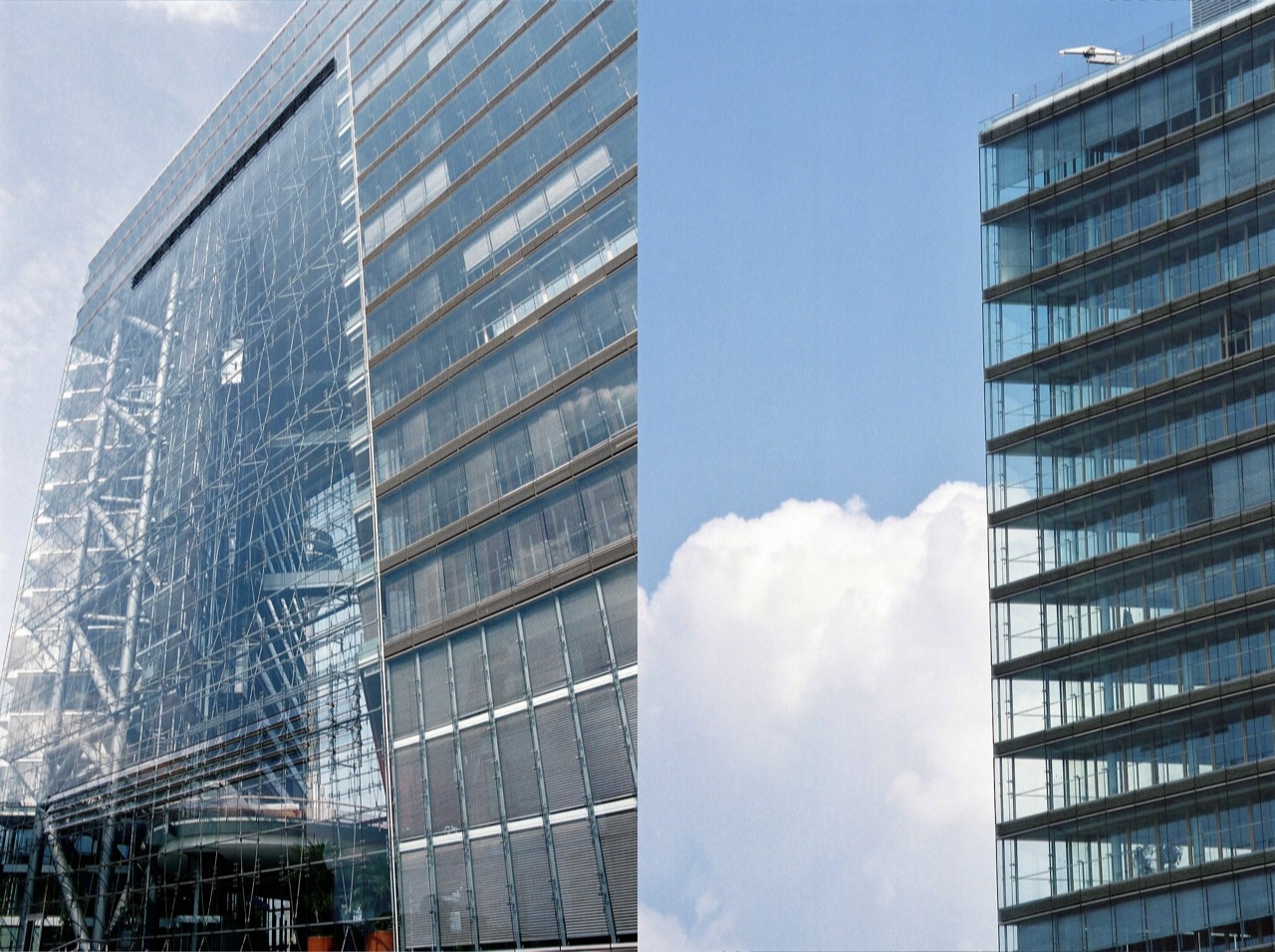
Two views of the double-skinned city gate designed by Petzika, Overdiek and Partner, Düsseldorf MedianHafen, Germany, image by Craig White
Essentially a nine-story glass cube, the former Occidental Chemical Center in Niagara Falls, New York, realized the first double facade in North America. An independent energy analysis found that the building would use just two percent of the energy of a traditional building for heating in winter and 19 percent annually for cooling. But grossly inadequate maintenance resulted in the mechanical air dampers stopping working and the air intake grilles being covered to prevent dirt and particles from a nearby excavation site from accumulating in the cavity. The system has been rendered virtually unusable and now serves as a cautionary tale for owners who habitually ignore and postpone building maintenance.
Critics claim that similar insulation levels could be achieved by using traditional high-performance low-E windows rather than having to sacrifice usable floor space for the cavity. The material and design costs of implementing the system can also be prohibitive; Therefore, double facades are still found almost exclusively in high-profile projects with large budgets.
Do you have any other design and development terms you would like to see in the Explainer? Share your thoughts and questions in the comments section below.
* * *
Do you have any other planning terms you would like to see in the Explainer? Share your comments and questions in the comments section below!
* * *
From 2015 to 2017 and then expanded in 2022, UrbanToronto occasionally published a series of articles under the heading Explainer. Each took a concept from urban planning, architecture, construction, or other topics that frequently appear in our publications and presented an in-depth look at it. We are revising these articles again (and updating them as necessary). While you may already be familiar with the terms and topics we explore, others may be new to you. We will (re)publish Explainer occasionally. Want to read other explainers? Click on the explanation box at the top of the page.
* * *
UrbanToronto’s new data research service, UrbanToronto Pro, provides comprehensive information on construction projects in the Greater Toronto Area – from proposal to completion. Additionally, our New Development Insider subscription newsletter lands in your inbox daily to help you track projects through the planning process.
* * *
* * *
Thank you to the businesses joining UrbanToronto to celebrate State of Environmental Month.