


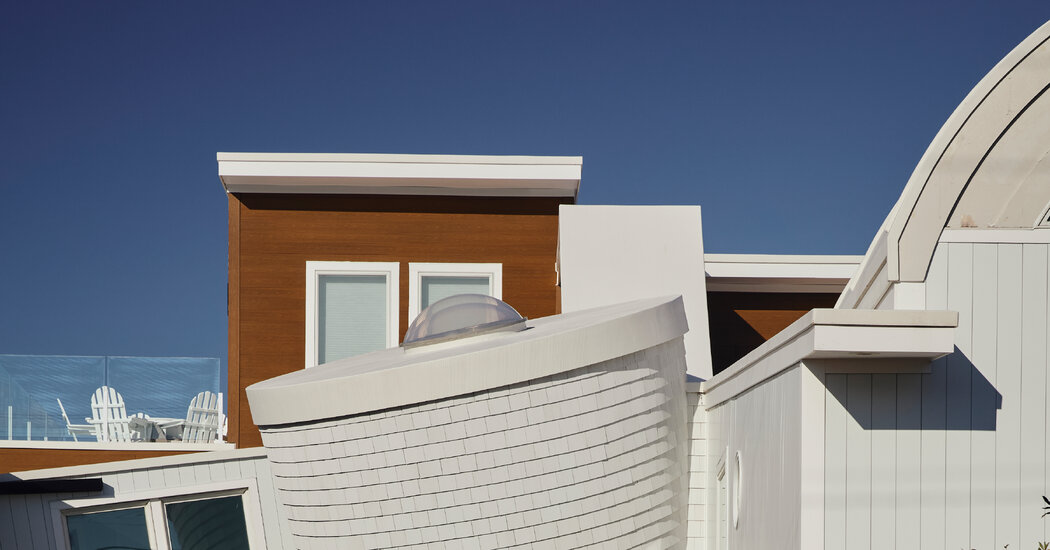
When Lori and Joel Kaplan bought their home on Long Beach Island, they didn’t have to come up with a name for the place, like Dunescape or Sea Breeze. There was already one: the Chicken Bucket House.
Located directly on the boulevard, the main thoroughfare of LBI, the home is a riot of slopes and curves. Chief among these is the sloped cylindrical space that juts out over the front door—a potentially controversial detail, considering it looks like an oversized order of KFC or like Oscar the Grouch would pop out.
“‘We can get rid of the bucket if you want,'” Ms. Kaplan recalled an architect telling her before drawing up renovation plans after the couple bought the house in 2013. Her answer: Absolutely not.
“It’s the bucket house!” she said. “That’s what makes it unique!”
The Kaplans’ home is hardly the only landmark on the quiet, upscale north end of this barrier island off the coast of New Jersey that has boasted boundary-pushing home designs for nearly a century. The Loveladies district in particular, with its larger properties and higher prices, has long been the LBI’s crucible for experimentation. The beach is dotted with a kaleidoscopic mix of cedar-shingled contemporaries, edgy geometric confections, and works of absolute modernism.
“There are three places along the entire East Coast with a tradition of modern architecture,” said local architect Stephen Midouhas, who designed his first modern home at LBI in 1976. “Cape Cod for Harvard, the Hamptons for the money, and Long Beach Island.”
However, nothing is permanent on an offshore island.
Decades after a collision of economic, cultural and meteorological forces created the ideal conditions for adventurous architecture, those same forces are now swinging the pendulum back toward a more conservative style. A wave of new construction – houses larger than ever before, many in the same Dutch Colonial style with gambrel roofs – is weakening Loveladies’ signature diversity and threatening its future as one of the densest collections of modernist and eclectic homes in the country.
“Is it a Hamptons thing?” wondered Dana Diorio-Clayton, a second-generation LBI broker who invoked the ultimate insult on this laid-back barrier island. “To me, it doesn’t scream LBI. It doesn’t even whisper it.”
The island’s modernist history dates back to the 1930s, when a young artists’ colony was based at the northern end. An art foundation established in Loveladies in 1948 by a sculptor trained by Rodin further encouraged the modernist movement. So does Loveladies Harbor, a planned community of modern homes planned in the 1950s by two Soviet spies-turned-real-estate developers.
Then the storm came. The Northeast of 1962 leveled much of the island, creating a blank canvas for architects just as the Garden State Parkway opened the waterfront to new visitors and new development. A crowd of renowned architects rushed in. Malcolm Wells gave Pyramid House to Loveladies. Richard Saul Wurman, a protégé of Louis Kahn, contributed his unusual, cylindrical sandcastles. And Robert Venturi built the pop art-inspired Lieb House (eventually brought to Glen Cove, NY on a barge in 2009 to avoid the wrecking ball).
In 1980, a young architect named Gym Wilson walked onto an empty oceanfront lot with a beach chair and a sketchpad. He had been commissioned by a Pennsylvania couple to design a summer home that emphasized outdoor living and maximized views and breezes.
“It was wide open,” Mr. Wilson said recently of the vast expanse of undeveloped dunes. “What a great place for architects.” The house he designed, an angular modern house with cedar shingles and crimson fiberglass “rostrums” that doubled as a roof, won a national architecture award in 1982.
Mr. Wilson, a Jersey Shore native, “floated” to LBI in the 1970s with a flair for design shaped by pioneers like Frank Lloyd Wright (his “leading man”) and Hamptons modernist Norman Jaffe. When Gym Wilson Architects put up its first shingle in 1978, it marked the beginning of a new era for architecture at LBI
When the building boom of the 1980s began, there were still only two architectural firms on the island: Mr. Wilson’s and a rival firm headed by another local, Oram Tonge. A decade later, her former interns would take up the baton. Mr. Tonge’s company founded Studio Tagland, which was responsible for crazy designs like the Chicken Bucket. Mr. Wilson’s first employees, Michael Ryan and Mr. Midouhas, became LBI’s preeminent modernists and collected architectural awards.
Soon they were building on their own work. In the 1990s, Mr. Ryan was commissioned to expand Mr. Wilson’s award-winning Bleachers House, designing a sprawling circular room addition – only to be commissioned again a few years later to design an entirely new house on the same site. The new owners, willing to forgo amenities like a garage for their architect’s vision, ended up with a bright red box floating 11 feet above the sand.
Built in 2001, the award-winning home that appears to float above the dunes is unlike anything else on the island. But now it’s overshadowed by a huge new shingle-like compound next door. The two houses offer competing visions for the future of LBI
And the writing seems to be on the wall: The red house has also just been sold.
“Buying or building a Mike Ryan home is like buying a sculpture,” said Joy Luedtke, an LBI broker who sold the home in 2024 for $6.75 million.
However, their customers increasingly have other priorities, namely a long list of amenities. Since the pandemic, buyers have wanted outbuildings that can accommodate their extended families, and homes are increasingly being used year-round. “An elevator is a must,” said Ms. Lüdtke. “A pool is a must. A Shangri-La in the backyard is a must.”
Just a short bike ride from the Chicken Bucket House, another crazy house, alternately called the Crooked House and the Leaning Tower of Loveladies, leaned precariously over the boulevard like a melting sandcastle. The Studio Tagland-designed building was sold in 2017 and replaced with a sprawling custom home with a Hamptons-style gambrel roof look.
The site embodies the latest LBI housing trend: a massive expansion, in this case from 2,900 square feet to 7,000 square feet and from zero to two pools. And while the trend at LBI has always been toward larger homes, the style, scale and pace of development has felt different over the last decade.
“Things have progressed rapidly since Sandy,” said local architect Jay Madden, another original Gym Wilson employee. The 2012 hurricane devastated the island and sparked a 1962-like construction boom. Experimentation was no longer the goal, and the Nantucket shingle style increasingly prevailed, covering the Hamptons and Cape Cod.
“Modern goes in and out of style,” said Michael Ziman, a prolific high-end developer on the north end. “As prices rise, people want to protect their investments. They don’t want to go too far out of the box.” (The island’s average sales price was nearly $2.5 million last year, an increase of more than 250 percent since 2014.)
Developers also need to be able to sell the properties they build. “If a developer wants to build a special house, they won’t hire me or Steve Midouhas,” said Sam Gordon, who has been designing modernist homes on LBI since the 1990s. “It has to be attractive to the mass market.”
This appeal tends to exclude the island’s more imaginative architects. Mr. Ryan complained that everything had to be “exhausted” today and described these colossal new buildings as “house piles”.
For Adrian and Christine Aery, who wanted to remodel their 1970 Loveladies home “to make it big enough for the grandchildren,” Mr. Aery said, the project came down to one factor: cost.
“We would have liked to have become modern 20 years ago,” Ms. Aery said. “But the price was exorbitantly higher.” Instead, they hired a contractor to build a more traditional home in its place.
The loss of more modern homes on the north end, particularly the historic mid-century remnants, is a sobering thought for architecture fans. “If you lose them, you lose a huge piece of humanity and innovation,” said Daniella Kerner, executive director of the LBI Foundation, an arts and community center that sponsored the region’s first experiments.
“Architecture adds great value to a community,” Ms. Kerner said. “It’s not about how many TVs or bathrooms you can cram into a house.”
But the extinction of modern architecture on LBI is far from a fait accompli. Mr Midouhas – who Mr Madden said “sets himself on fire and leaves blood on the drawings to make a real artistic statement” – has just broken ground on his biggest project in 50 years – his first seafront at Loveladies. The fate of the existing modern houses in the neighborhood lies in the hands of their future owners.
One afternoon last fall, Mr. Ryan, recently retired, was walking on Loveladies Beach. As he approached the recently sold red house—perhaps his masterpiece—he braced himself for signs of impending demolition. But he was surprised to see workers carefully touching up the red paint. The new owners decided to keep the house.
“They’re restoring it,” he said to his wife later that day. “It looks great.”