


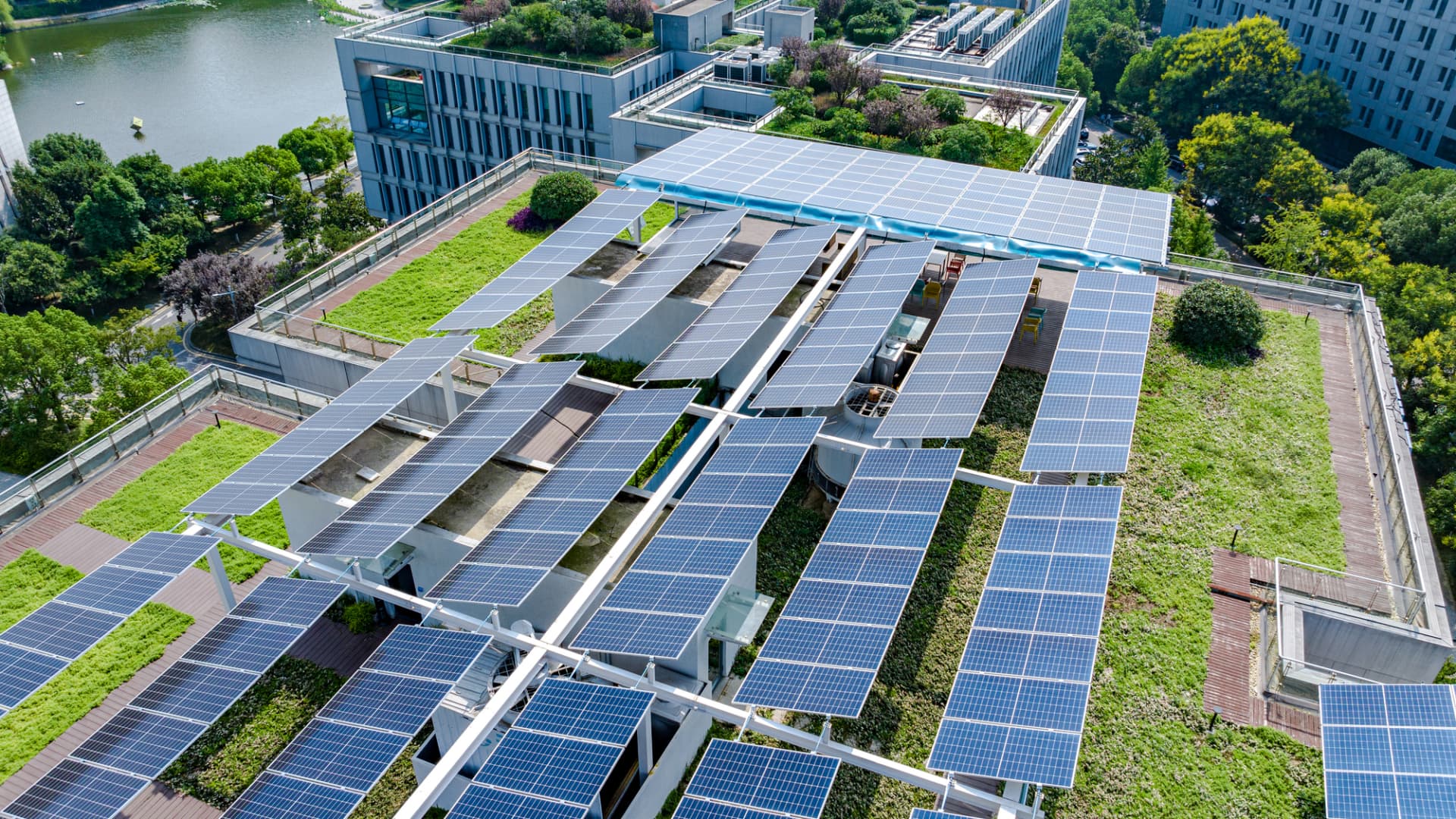
Wepro | moment | Getty Images
A version of this article first appeared in the CNBC Property Play newsletter with Diana Olick. Property Play covers new and evolving opportunities for real estate investors, from individuals to venture capitalists, private equity funds, family offices, institutional investors and large public companies. Sign up to receive future issues straight to your inbox.
A special type of loan that helps commercial building owners finance major upgrades to save energy or water, add renewable energy or improve resiliency is seeing tremendous growth in what is expected to be a tough credit environment.
This month, Nuveen closed a $465 million C-PACE deal for The Geneva, a landmark office-to-residential conversion in Washington, DC. The transaction represents the largest C-PACE financing in history.
C-PACE stands for Commercial Property Assessed Clean Energy and is a type of financing that differs from a traditional bank loan. It operates at the state level and requires local leaders to pass appropriate legislation. The loan amount is added to the property’s tax bill and is repaid over a long period of time (often up to 20 or 30 years). This can make energy conservation projects more affordable because payments are spread out, usually at fixed rates, and the upgrades can reduce operating costs and increase property values.
Between 2009 and the end of 2024, cumulative C-PACE investments reached nearly $10 billion, according to PACENation, a nonprofit that says it advocates for C-PACE financing.
However, growth has accelerated significantly over the past five years – with C-PACE lending posting double-digit increases – as more states adopt policies implementing the program and more owners and lenders adopt the tool to finance projects. Currently, 40 states have C-PACE policies with 32 active programs, up from six active programs in 2015.
Nuveen has closed $2.1 billion in C-PACE loans across 53 deals in 2025 alone, providing a total of over $5 billion. In September, Nuveen completed its second-largest C-PACE transaction to date for $290 million for the Pendry Hotel & Residences in Tampa, Florida. The closing also marked the first C-PACE-financed transaction in the City of Tampa.
Nuveen said upgrades funded by its C-PACE loans have saved over 300,000 tons of carbon dioxide.
But it’s not just about the environment, and lenders are quick to admit this, especially as the political winds turn away from decarbonization.
Get Property Play straight to your inbox
CNBC’s Property Play with Diana Olick covers new and evolving opportunities for real estate investors, delivered weekly to your inbox.
Sign up here to get access today.
“The fundamental need to operate real estate more resiliently and efficiently is really not going away,” said Alexandra Cooley, CEO and CIO of Nuveen Green Capital, a subsidiary of Nuveen. “In fact, the vast majority of projects we see – the last time I checked it was 97% – are some combination of either energy efficiency, which reduces the property’s operating costs, or climate resilience. So a very small percentage is actually renewable energy.”
Indeed, it is the mechanism that is becoming increasingly attractive to lenders in a longer-term higher interest rate environment where economic policy uncertainty has hit traditional commercial real estate bank lending hard. For institutional clients who want a long-term commitment with a fixed interest rate, it is attractive because C-PACE loans are secured by a priority tax assessment on a property.
“Our borrower is actually the property itself, not necessarily the individual owner of that property. So that’s safer and allows our long-term investors to have that term,” Cooley explained.
Another major player in the space, Peachtree, closed its largest C-PACE deal, a $176.5 million loan for the Rio Hotel & Casino in Las Vegas, Nevada, for renovations that were actually completed in 2024. The loan was structured to fund these renovations retroactively, allowing the owners to reduce their senior loan obligations, another benefit of the C-PACE product.
“They can be used as a rescue capital mechanism if you have just opened a new development project, a new hotel project, an apartment building or any type of commercial property, and you could technically take out a retroactive C-PACE loan to recapitalize that project and repay the bank or lender that financed the project,” explained Greg Friedman, CEO of Peachtree Group.
Friedman said he views C-PACE as an economic development tool at a time when “commercial real estate capital markets have collapsed.”
“Banks account for 50% of the commercial real estate lending market. Banks are typically the lender of choice for new construction and new development projects, and they simply do not lend at the same volume,” he said.
C-PACE is very profitable for Peachtree as a company, Friedman said, because the company can consolidate and securitize the loans.
“We have a lot of insurance companies that will invest in these securitizations,” he added.
While C-PACE lenders are less focused on the “green” aspects of the loan, they are still attracted to the “resilience.”
C-PACE loans can be made to finance energy-efficient upgrades, which save money overall and add value to the building, but they can also be made to improve the building’s resilience. This includes protection against floods, fires and even earthquakes. This is also attractive for investors as climate catastrophes are getting worse.
Cooley said she sees three things driving expansion in this area: more states adopting C-PACE programs, market education and awareness, and investor interest.
“As institutional investors have come in, the cost of capital and structure of C-PACE has become much more compelling to the commercial real estate industry,” she said.