


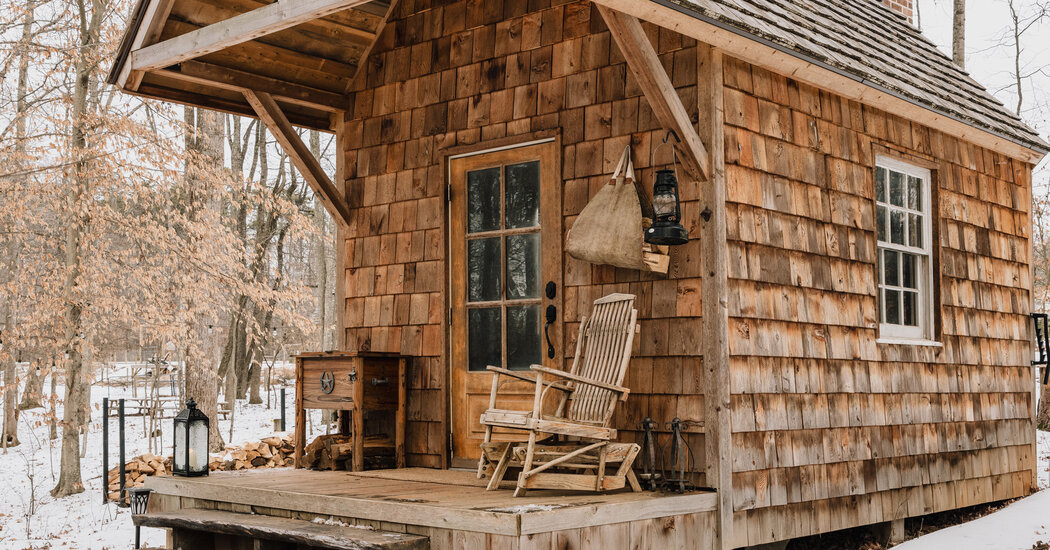
Jasper and Satchel Sieniewicz can’t believe it was a one-man job.
As children, their father read to them Henry David Thoreau’s “Walden,” which details how Thoreau built his cabin on the eponymous pond in Concord, Massachusetts, using hand tools to shape beams from fallen wood and recycling wood from a fishing shack. He did all this alone, except for setting up the frame with a few friends, although Thoreau himself describes this as “more out of good neighborliness than out of any necessity.”
After the brothers build a full-scale replica of Thoreau’s cabin in the woods behind their family’s vacation home in Maine, they don’t buy it. Even with a sawmill and power tools, they needed work for three summers starting from the first summer of the pandemic, on and off between school and work, plus the help of their father, Tom Sieniewicz. Thoreau lived in his cabin in less than three months.
“There’s no way he did it on his own in the time frame he claimed he did,” said Jasper, now 23.
No registry records how many people have made replicas of Thoreau’s cabin, but they exist all over the country, built for private use, writers’ retreats, academic purposes and as Airbnb rentals. To support the projects, the Thoreau Society began selling blueprints of the 10-by-15-foot cabin in its gift shop about seven years ago. And at the Sam Beauford Woodworking Institute in Adrian, Michigan, you can enroll in a four-week “Walden Cabin Series,” where you’ll learn all the skills necessary to build your own cabin using only the tools and technology of the time. (Ax craft gets its own week.)
In 1845, Thoreau moved into his one-room cabin in the woods and lived there for two years, two months, and two days in considerable (though not total) silence, wanting, as he wrote, “to emphasize only the essential facts of life.” He published his account of this experience, “Walden; or, Life in the Woods” in 1854.
Today it seems strange to imagine a man so overwhelmed by 19th-century society that he sought such an expansive retreat. Back then there was no electricity, no cell phones, no harassing AI chatbots. But Thoreau’s recipe for a simpler, more natural life is a tantalizing response to this unprecedented moment of political, social and technological chaos. That’s probably why his legacy has endured for so long. Perhaps that is why he is far more popular as a writer today than at any time in his life. (The first printing of 2,000 copies of “Walden” took more than five years to sell; it has since been translated into nearly every language spoken on Earth.)
Maybe that’s why people build his hut.
Build castles in the air
The Sieniewicz brothers had originally hoped to build a treehouse, but the elder Mr. Sieniewicz, an architect, forbade them from damaging or removing live trees on the property, leading to a turnaround: “I somehow convinced them that building Henry David Thoreau’s cabin was their idea,” he said.
The boys had visited the site in Concord with their father years before, but admittedly the interest in Transcendentalism lay primarily with him, particularly as the philosophy emphasizes individualism, self-reliance, and a connection to nature. Still, with his blessing, they were willing to build the cabin, using mostly recycled materials and milling their own wood from fallen trees they found in the forest. “Give a couple of teenagers a commercial chainsaw, what could happen?” Tom Sieniewicz joked. The boys acquired the new skills they needed by watching YouTube videos; They learned the rest in woodworking classes as children.
Not everyone building a replica Walden cabin takes as much time as the Sieniewicz family because not everyone takes such a strict environmental approach. But like them, most of them made it a group effort.
Jim and Rachel Van Eerden built a “barn” for their cabin in Stokesdale, North Carolina, with friends building historically accurate furniture, a contractor working on the framing, and even a blacksmith forging 1850s-style nails. Her “Walden” cabin is the first of a growing series of literary-inspired structures on her homestead property, available for rent through Airbnb and VRBO. The listing specifically warns potential visitors about the lack of plumbing, electricity and Wi-Fi; Showers and toilets are instead available in the nearby Narnia Cottage.
The interior of her cabin is almost Thoreau’s model, even the dents and nicks in the wooden desk are the same as the author’s. However, they made some additions to the structure. “We gave ourselves what we called the ‘third year freedom’ by saying, ‘Okay, if Thoreau had stayed a third year, he would have wanted a little porch. He would have wanted a garret,'” Mr. Van Eerden said.
Jeffrey Ryan originally planned to build his cabin on his own to emulate Thoreau, but he turned around after nearly falling from an 8-foot ladder. “That’s when I said, ‘Time out, I’m calling for help,'” Mr. Ryan said. He completed work on his cabin with the help of a childhood friend and built it in the woods behind his home in Maine. In keeping with Thoreau’s environmental ethos, he sourced used and recycled materials wherever possible – many of the wooden beams were leftover from the construction of his main house, the woodstove was a gift from a neighbor, and the antique windows were purchased on Facebook Marketplace. “I have remained remarkably faithful to his vision,” he said. He also stuck to Thoreau’s costs: Mr. Ryan spent $1,670 on supplies. Thoreau spent $28.12½; about $1,200 in today’s dollars.
But for others, using Thoreau’s exact methods is beside the point. Kevin Klein built his cabin in the woods behind his home in Hingham, Massachusetts, two years ago and asked his stepfather, a master carpenter, for help. He paid a contractor to put up the roof and spent about $4,500 on materials from Lowe’s. “This is not a strict, historical fetishization project,” he said.
Mr. Klein first met Thoreau when he saw “South Park” in high school. In a first season episode, Cartman wins a writing contest by plagiarizing “Walden,” and Mr. Klein, curious and unknown, bought a copy. It’s still on his bookshelf and he’s read it several times.
Simplify, simplify, simplify!
Even before “Walden,” critics questioned Thoreau’s motives for building and moving to his isolated cabin. “I think it touches a lot of nerves,” said Laura Walls, a scholar of American transcendentalism. “What a lazy bum this guy must be, not engaging in society and so isolating himself,” she said, paraphrasing his critics.
But for fans of Thoreau, that individualism is the appeal, “the whole idea of leaving society behind, rebelling against industrialization and being self-sufficient with hand tools,” said Luke Barnett, whose Sam Beauford Woodworking Institute offers the Walden cabin series. Mr. Barnett first met Thoreau in fifth grade and was bribed with Snickers bars as part of a reading program. “I loved it,” he said, “it’s kind of dry, we shouldn’t lie and pretend it wasn’t. But the concepts in it attracted me and I re-read it every few years.”
As a child, Mr. Barnett experienced periods of homelessness and began his career as a woodworker after dropping out of high school. Although most of his work involves power tools, Mr. Barnett still sees the value in doing things by hand and offers his course to empower like-minded woodworkers and outdoors people. “With these tools they can build anything they can imagine. They don’t even need electricity,” he said. “No one can ever take that away from you. You are completely independent.”
Thoreau not only advocated for self-reliance, but was also an early environmentalist. Today’s Walden Pond is lush with trees thanks to a government conservation program, but Thoreau witnessed huge tracts of forest being cut down by loggers. He was among the first to lament its loss and among the first to question the rampant consumerism that led to its decline. As an abolitionist, Thoreau avoided sugar made through slave labor and wore simple clothing instead of the new Parisian fashion.
Today it is difficult to be an ethical consumer of food, clothing, shelter or even entertainment. But a few hours alone in a simple cabin can provide some perspective. Dr. Walls explained: “The point for Thoreau was a conscious experiment in simplifying our desires – what we think we want – and trying to get to the heart of what it means to live a fulfilling life.”
The great ocean of loneliness
Independence does not mean loneliness. That wasn’t the case for Thoreau – while living in Walden, he regularly went to Concord for supplies, visited friends, and dined with his family.
But sometimes he also needed a break. During his time in Walden, Thoreau read and wrote, swam in the lake, and spent hours in complete silence, watching nature transfixed from his doorstep. “I grew in these seasons like corn in the night,” Thoreau wrote of the experience.
For Mr. Ryan, his cabin provides a quiet space just for writing. “The simplicity invites concentration,” he said. All he has is a kerosene lamp, a desk modeled after Thoreau, and bookshelves full of research material (to avoid using Google). “Of course, this means that I don’t want to spontaneously check emails. I’m there to write.”
Mr. Klein primarily uses his cabin as a quiet place to smoke his cigars. He, his wife and their four children hike in the woods behind their house and occasionally sleep in the cabin, using mats and blankets from the house.
The Van Eerdens only occasionally have the opportunity to read in their hut; It’s usually booked for about $130 a night. “We literally had guests from Germany, from New Zealand, from Paris, from London, all arriving with the excitement of slipping into a book that shaped them,” Mr Van Eerden said. Sometimes the excitement exceeds the experience; He had to explain to some guests how to start a fire in the fireplace.
Jasper Sieniewicz has read some of Thoreau, but not as extensively as his father. “I’m sure it’s instilled in me in ways that I’m probably not even really aware of,” he said. His father furnished the cabin authentically, with hard wooden chairs and a desk; If Jasper had his way, there would be a couch instead, but he realizes that his father will spend more time there than he and his brother, who are busy building their careers as engineers.
Satchel stayed there a few years ago with his girlfriend at the time. “I would honestly be too scared to stay there alone,” he said.
“These woods are scary.”