


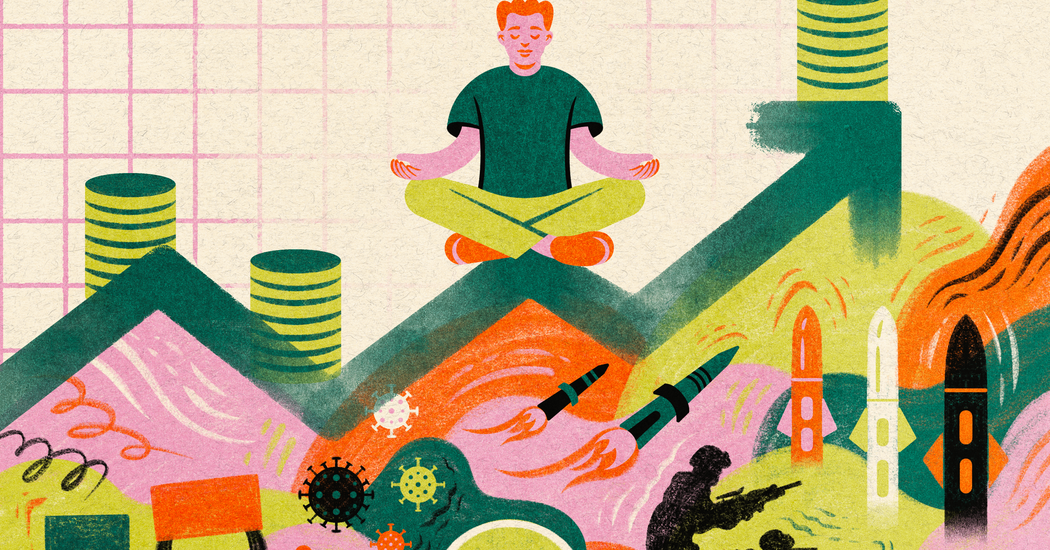
At the same time, political unrest in many countries led to a breakdown in global economic and political relations, he said. For example, the Trump administration’s increasing immigration crackdown, which has led to domestic unrest, is often seen in other countries as an integral part of “America First” policies that shatter illusions of global cohesion. And anti-immigrant sentiment is widespread in other countries.
“It’s all part of the vicious cycle,” he said.
The war between Russia and Ukraine continues. The last nuclear arms control treaty between Russia and the USA has expired. China is rushing to acquire a larger arsenal, Europe is discussing creating its own larger deterrent force, and countless smaller powers are reaching for nuclear weapons if they don’t already have them. The possibility of a direct conflict between the US and China in the Taiwan Strait or the South China Sea cannot be ruled out.
Follow the money
Professor Prasad sees economics as the ultimate source of strength. Therefore, in his opinion, the USA and China are superpowers. Russia, whose economy is smaller than Brazil’s, is not. However, a strong military force remains, endangering large parts of Europe and still capable of wreaking havoc across the planet. The USA’s traditional allies in Europe – and on all other continents – had to realize that they cannot unconditionally count on the United States led by Trump.
Largely thanks to the Trump tariffs, the old free trade system is evolving into a series of incipient trade wars that are sparking further conflicts. Mr. Trump is using tariffs to punish — or reward toleration — on issues that have nothing to do with trade itself. Greenland, immigration, drug flow: When countries resist the president’s demands, he imposes more tariffs. Douglas Irwin, a Dartmouth economist and expert on the history of trade, told me in a telephone conversation that using tariffs in this way is “simply extraordinary in U.S. history.”
In our conversation, Professor Prasad, who like me is an old China expert, said that China shares responsibility for the collapse of global trade relations. It is causing immense damage by flooding the world with more exports than most countries can easily absorb, he said. China has long needed to reorient its economy toward domestic consumption—which would make it less dependent on aggressive exports for growth—but has been unable or unwilling to do so.