


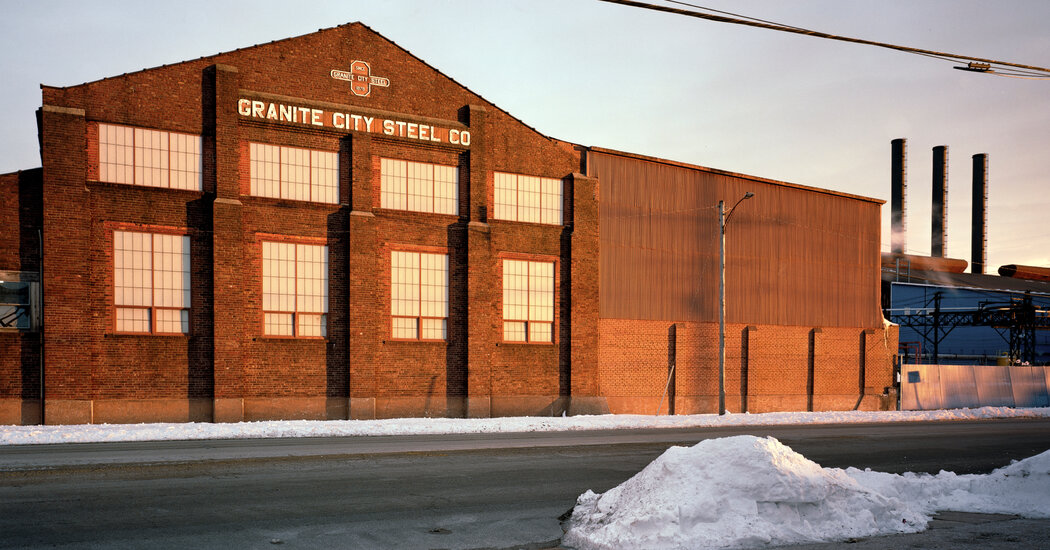
The news that the Granite City steel mill was restarting a blast furnace was seen as a sign of the revival of American industry.
The Trump administration had imposed high tariffs on steel and aluminum. This was intended to curb imports and shift production back to American factories. And here, in a huge complex on the Illinois side of the Mississippi, was apparent proof that the strategy was working. US Steel, the plant’s owner, would hire about 400 additional union workers.
“These tariffs helped,” said Braden Morris, who was laid off from his job at the factory in late 2023 and had just been recalled. “It’s proof that we’re coming back.”
But 500 miles farther north, in freezing St. Paul, Minnesota, those same tariffs meant something different to Eric Hawkins. His family business, Park Tool, manufactures bicycle repair equipment and exports it all over the world. The tariffs have increased the cost of the steel and aluminum it uses to make its products. That forced it to raise its prices by 10 percent, flattening sales growth.
“Every one of our suppliers has increased prices over the past year,” Mr. Hawkins complained. “Trump thinks it’s so easy to say, ‘We’re going to make the costs so high that we have to bring the jobs back.’ But I have to expect significantly higher material costs.”
And that was before the latest upheaval in American trade policy: Friday’s Supreme Court ruling that President Trump’s so-called reciprocal tariffs – levied against numerous countries at once – had exceeded his authority.
That decision confronted the American economy with an overwhelming array of variables and prompted Mr. Trump to immediately resort to a new global tariff of 15 percent, using a different legal mechanism. This also made steel tariffs, which were not the subject of the court case, a more important part of trade policy.
“The Supreme Court’s ruling, bad as it was, significantly strengthens all other statutory authority that President Trump has regarding tariffs,” Peter Navarro, Trump’s senior adviser on trade and manufacturing, said in an emailed response to questions. He cited the section of the law that served as the basis for imposing duties on steel. “The steel tariffs are rock solid and a linchpin of an industry that is critical to our national security.”
Mr. Trump has made protecting America’s steel industry the centerpiece of his mission to revive domestic factory production. But Park Tool’s problems highlight how tariffs have hampered that cause so far and threatened existing jobs.
Protectionism has increased the price of steel available in the United States while leading to only a modest increase in domestic production. This means that companies like Park Tool are dependent on global supply chains that they have built up over decades. Thousands of specialized components needed to make their products are now more expensive.
Manufacturers are also grappling with a foreign backlash over the Trump administration’s broader trade war, undermining the appeal of the “Made in America” brand. Last but not least, they struggle with paperwork nightmares while navigating ever-changing customs rates and procedures.
The Trump administration contends that disruption is the inevitable price of revitalizing steel towns like Granite City. But this characterization clashes with the arithmetic of American manufacturing. According to a study by economists Kadee Russ and Lydia Cox, for every person employed at a domestic steel mill, 80 work in factories that buy steel.
Tariffs during Mr. Trump’s first term led to an additional 1,000 jobs in steel mills while eliminating 75,000 jobs across manufacturing, the two economists calculated in a separate paper.
Representatives of the steel industry argue that such formulations ignore important connections.
“If there is no steel production in your country, you are at the mercy of steel producers in other countries,” said Kevin Dempsey, president of the American Iron and Steel Institute, a trade association in Washington.
He called Mr. Trump’s tariffs an overdue correction to massive steel shipments to the United States, much of which is unjustifiably cheap due to subsidies.
In 2016, the year before Mr. Trump’s first term, about 71 percent of America’s steel capacity was in use, according to industry data. By 2019, when steel tariffs were introduced, this figure had risen to 80 percent and has been over 75 percent since then. At the same time, the share of imports in all steel used in the United States fell from 27 percent to 19 percent.
But even as American steel imports declined, total production in the United States remained unchanged.
From 2019 to 2025, domestic steel production fell from 97 million tons per year to 90 million tons, although last year saw a slight increase from the previous year, according to data from the American Iron and Steel Institute.
Experts claim that the tariffs have allowed the industry to save on investments while benefiting from higher domestic prices. Steel sold in the United States is currently about 30 percent more expensive than in Europe and almost twice as expensive as in China, noted Kyle Handley, an economist at the University of California, San Diego.
Granite City is evidence of the forces of decline that have plagued America’s industrial communities in recent decades. Brick buildings stand abandoned, their masonry crumbling. Dollar stores and payday lenders fill the retail spaces. At the United Steelworkers Local 1899 headquarters downtown, footsteps echo through empty hallways.
Three years ago, before the layoffs, the union represented 1,400 local workers. In December, shortly before the restart of the blast furnace was announced, the number had fallen to 764. Now some of the people who were sent home two years ago are being recalled.
“These tariffs have helped position steel where it is by creating demand for American steel,” said local President Craig McKey.
Eric Addison, 34, had just returned to the mill. He grew up in Granite City and long aspired to get a job as a steelworker.
“This place was the talk of the town,” he said. “You would ask anyone who had a nice house or a car and they would say, ‘Yes, we work in the steel mill.'”
Shortly before his dismissal, he had been promoted to ladle, where he operated the controls of the system that regulates the flow of molten steel. He earned more than $29 an hour. “It was the best money I ever made,” Mr. Addison said.
After being discharged in October 2023, he took a job with an inland waterway company that transports animal feed down the Mississippi River. It paid less than $22 an hour. He stopped eating. He eliminated bowling night. “Basically I just went to work and came home,” he said.
Then, in December, he saw a post on Facebook announcing that the furnace would be back in operation. Almost immediately the company called and asked him to come back. It would start at $31.20 per hour.
“I was pretty excited,” he said.
Many local mill workers praised the change in leadership in Washington. “In this city we were always told we made the best steel, but the influx of cheap steel hurt us,” said Martin Cooper, a 57-year-old father of four who was recently recalled. “People say Trump came back and reopened the steel mill.”
But the same conditions that inspired confidence in Granite City are sowing concerns across the American factory floor.
Mr Hawkins, 63, the managing director of Park Tool, now expects his fortunes to rise. Over the last quarter century, he turned the bike shop founded by his father and a partner into one of the world’s largest manufacturers of bicycle tools. The company exports more than half of its production to around 70 countries, including China.
But these days he and his 70-person team are struggling with the effects of Trump’s trade war. The time that they would rather spend developing new products is wasted studying tariff plans and preparing customs paperwork.
“It’s just a lot of trouble,” Mr. Hawkins said. “We should be in a growth pattern. We’re not.”
Old Schwinn bicycles fill racks near the factory entrance, showing the company’s roots. But the present is underscored by the studio, where the company records bicycle repair videos and posts them on YouTube to promote its products.
As Mr. Hawkins walked through his factory one morning, he stopped at a workbench where a worker was using a hand drill to attach parts to a so-called torque limiter – a wrench designed to prevent a person from exerting harmful forces. One part, a blue-tinted lump of metal shaped like a handle, had been cast in a factory in Iowa. Another was injection molded in the Twin Cities.
These were the elements of a factory that managed to stay in the United States despite the constant onslaught of cheap labor in Asia.
But lately Mr. Hawkins has had to face new challenges. A dealer in Germany recently told him that many of his European customers, angered by the Trump administration’s attempts to take control of Greenland while weakening their support for Ukraine, are refusing to buy American products. The retailer has shifted some of its orders to a factory in Slovenia.
Mr. Hawkins is tormented by talk of tariffs boosting American manufacturing. Its own operation has established a supply chain that uses domestic sources for most of its parts and materials. But around 3,500 components come from Asia, most of them from Taiwan. Nobody can recreate that so easily.
He pointed to a stack of aluminum parts waiting to be attached to poles to form a bicycle repair stand. The part that held the bike frame was made in Taiwan. The mold costs about $15,000 to make there, compared with $80,000 to $90,000 in the United States, he said.
“There are so many moving parts here that all have to work together,” he said. “We spent 60 years figuring this all out and it works. I’m not just going to throw this away.”
And as Mr. Hawkins tried to understand the implications of the Supreme Court’s decision, he expected even more tariffs in response.
“Who knows?” he said. “Everything could change tomorrow, right?”