


A new multi-stage funding agreement between the federal and provincial governments, involving the City of Toronto, is set to transform the way housing and transportation projects move forward across Ontario. Today it was announced that the Canada-Ontario Partnership to Build will provide $8.8 billion over 10 years for housing-supporting infrastructure, coupled with reductions in community development fees and complemented by a full HST rebate on qualifying new homes. In addition to measures to reduce construction costs and accelerate new deliveries, the agreement also advances several key transit priorities, including a long-awaited three-way funding commitment for the Waterfront East LRT.
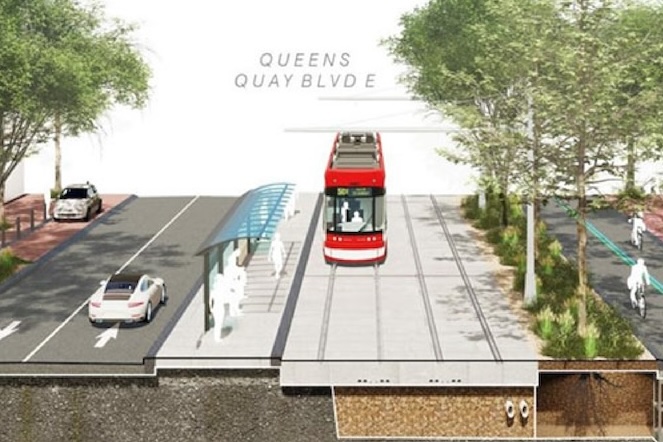
Rendering of the Waterfront East LRT, image via Waterfront Toronto
A central part of the agreement targets development fees, which now make a significant contribution to the rise in housing costs. The federal and provincial governments would jointly commit $8.8 billion to growth-enhancing infrastructure, with funding given priority to communities across Ontario that commit to reducing housing rates by 30 to 50%. These cuts would have to remain in place for at least three years, with participating municipalities expected to identify construction-ready infrastructure projects that are consistent with housing delivery goals.
In addition to these measures, the agreement establishes a temporary HST rebate program intended to reduce purchase prices for new homes. For eligible buyers, the full 13% HST would be waived on homes valued up to $1 million, for a maximum benefit of $130,000. This full discount would extend to homes priced up to $1.5 million and then gradually decrease to $1.85 million. The program would apply to sales contracts signed between April 1, 2026 and March 31, 2027, subject to relevant legislation. The measure is expected to result in around $2.2 billion in tax relief.
Within Toronto, the agreement’s most concrete result is a long-awaited funding commitment for the Waterfront East LRT, which would stretch across the East Bayfront and Port Lands. While plans for the corridor have been circulating for years, this is the first time that all three levels of government have agreed on a cost-sharing framework to advance both planning and construction. Current estimates put the project at about $3 billion, with the federal, provincial and local governments each contributing about a third.
Proposed map for the Waterfront East LRT, image via Waterfront Toronto
The line is expected to serve a rapidly growing section of the city’s waterfront, serving more than 150,000 residents and providing over 50,000 daily trips. The corridor is also ripe for development, with forecasts showing capacity for around 75,000 new homes.
The project would also extend the existing streetcar network eastward from its current terminus near Bay Street and require new above-ground and underground connections as part of Toronto’s waterfront transit system. As a result, the line would play a role in unlocking large-scale residential growth along the eastern waterfront.
Although funding commitments are now in place, the project is still in the planning phase, with the detailed design and implementation timelines yet to be determined. The City of Toronto has already moved forward with preliminary design work.
Queens Quay Public Realm with Waterfront East LRT, image via WaterfrontToronto
Beyond the waterfront, the agreement signals a renewed focus on expanding regional rail service through the emerging GO 2.0 framework, although details are still limited. The initiative focuses on improving passenger service along freight corridors throughout the Greater Golden Horseshoe, which includes corridors such as the Milton Line, whose service expansion is limited by third-party ownership. The materials specifically address the potential for new bypass tracks within the Milton Corridor and highlight possible approaches that could separate passenger and freight traffic to increase service levels.
The materials also suggest that a potential new route such as the Midtown Rail Corridor could play a role in the future expansion of GO service, while also suggesting that the Alto high-speed rail initiative, connecting Toronto with Ottawa, Montreal and Quebec City, could share parts of the new or upgraded infrastructure. A connection from Alto to Pearson Airport is also mentioned.
GO Midtown Toronto Corridor, image courtesy of TransitToronto.ca
The agreement also confirms continued coordination on a number of previously announced transit projects in the Greater Toronto and Hamilton areas, with both governments aiming to finalize contribution agreements in the near term. These include the Ontario Line 3, Eglinton Line 5 West Extension, Danforth Line 2 Scarborough Subway Extension, Yonge Line 1 North Subway Extension and Hamilton LRT, all of which remain central to the region’s broader transit expansion program. No new scope or timelines have been introduced, but the commitment strengthens the focus on further development of projects already in the pipeline.
At the municipal level, the agreement builds on a number of measures the City of Toronto has already introduced to reduce costs and stimulate housing construction. More than $760 million has been allocated for relief from development fees and charges, including exemptions for over 6,000 purpose-built rental units, a 15 percent property tax abatement for new multifamily housing, and the freezing and deferral of development fees for select projects. Other changes, such as the elimination of development fees for smaller apartments and the elimination of the conditional approval policy tied to fee rates, aim to improve project feasibility.
* * *
UrbanToronto’s research and data service, UTPro, provides comprehensive data on construction projects in the Greater Golden Horseshoe – from proposal to completion. Other services include instant reports, downloadable snapshots based on location, and a daily subscription newsletter, New Development Insider, that tracks projects from the first application.