


Throughout April, UrbanToronto is offering a special State of Environment editorial series to examine critical sustainability issues in our region.
* * *
The Toronto Green Standard (TGS) is Toronto’s sustainable design requirements for new private and city-owned developments, consisting of levels of performance measurements with supporting policies that promote sustainable site and building design and encourage sustainable design through incentives.
In existence since 2009, the TGS addresses urban environmental priorities such as improving air quality and reducing the urban heat island effect, reducing energy consumption and greenhouse gas emissions from new construction, reducing stormwater runoff, protecting and improving ecological functions, reducing building-related bird collisions, and diverting residential and construction waste from landfill.
The TGS includes minimum requirements for new buildings as well as an incentive stream for development fees. More than 4,000 developments have met these requirements and an average of 13 percent of housing applications have participated in the incentive program. By the end of 2025, 125 high-performing new developments have been certified through the incentive stream and 26 city-led net-zero emissions developments are under construction.
Toronto’s greenhouse gas emissions by sector, image via toronto.ca
“The Toronto Green Standard was introduced to promote more sustainable development in the city in response to concerns about future weather and the need to be resilient,” says Shayna Stott, senior planner of environmental and urban planning for the City of Toronto. “The reasons for introducing TGS are even more relevant today as the city faces an increasing number of extreme heat days, heavy rains and floods each summer, and the need to reduce energy costs and consumption through more energy efficient buildings.”
As Toronto finally emerges from a relentless and brutal winter, it’s easy to forget the intense heat waves of summer, when TV reporters fry eggs on the sidewalk or the heat bends train tracks.
“Toronto residents remember that we have a heat warning as early as May or as late as October, as the number of extreme heat days above 30°C has already increased compared to the 1980s,” says Stott. “By the end of the century, extreme heat days are expected to continue to increase, with two additional months of oppressively hot temperatures each year. Extreme heat is just one of the many interconnected risks Toronto will face due to climate change, including health impacts, disruption to infrastructure due to flooding, and strains on emergency and municipal services.”
The city has received positive feedback from developers, architects and landscape architects as the TGS has proven to be a successful market transformation tool by raising the minimum standard for development to have less environmental impact. Green roofs, bird-friendly glass, soil cells to protect trees while supporting infrastructure and energy modeling are now regularly seen in new developments thanks to the TGS.
“The TGS has brought consistency and predictability to sustainability requirements for developments across Toronto,” says Stott. “Developers building at the higher performance levels of TGS can receive reimbursement of development costs, and architects and landscape architects appreciate having the specifics of the sustainable performance metrics outlined in an easy-to-use manner.
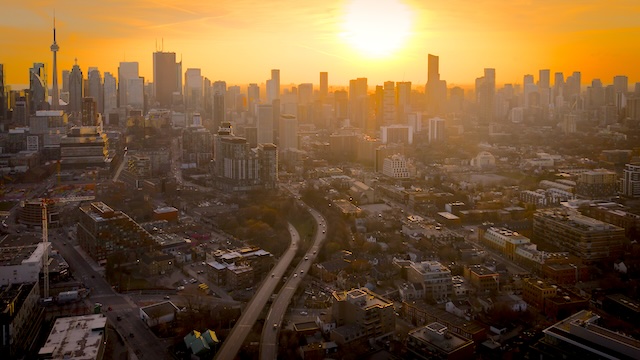
Looking west over Toronto, with the Adelaide and Richmond ramps in the foreground, image by hawc, UrbanToronto Forum contributor
Of course, the City of Toronto is affected by any new provincial legislation. City staff is currently reviewing the Building Homes and Improving Transportation Infrastructure Act, which was introduced March 30Thbecause of its possible effects. Additionally, in 2025, the Ford government introduced Bill 60, formerly Bill 17, Ontario Getting Homes and Infrastructure Built Faster and Smarter, provincial legislation aimed at cutting red tape and accelerating home construction. The Ontario government attempted to limit the importance of municipal environmental standards, particularly viewing the TGS as a constraint on housing construction. However, according to city planning officials, this did not change the city’s ability to apply the TGS to new developments.
April is a migratory month for birds returning north from the south, and another important part of Toronto’s overall sustainability in urban planning is the Bird-Friendly Development Guidelines developed in 2007. The city was the first jurisdiction in North America to develop bird-safe building guidelines, mandating the design of new buildings to reduce bird deaths due to collisions with windows. We are proud that this is a made-in-Toronto success story, as the guidelines have been adopted elsewhere and have inspired innovation among glass manufacturers to bring a range of bird-friendly glass products to market that are available across North America.
“These guidelines have evolved into development standards that are applied to all new buildings under the TGS,” says Stott. “To address the impact of nighttime light on migratory birds, the TGS requires that all outdoor lighting fixtures for new developments be Dark Sky compliant and that lighting on roofs and exterior facades must be directed downwards and turned off between 10pm and 6am. Our Lights Out program reminds building owners to turn off lights during the spring and fall migration seasons and we run a social media campaign to raise awareness. We hope more buildings will join in and turn off lights at night when not in use.” We will delve deeper into bird-friendly development policies. This is an upcoming story.
As our planet faces increasing environmental pressures, the city is doing its part through the Toronto Green Standard and other initiatives, providing a path to more sustainable urban planning.
* * *
UrbanToronto’s new data research service, UrbanToronto Pro, provides comprehensive information on construction projects in the Greater Toronto Area – from proposal to completion. Additionally, our New Development Insider subscription newsletter lands in your inbox daily to help you track projects through the planning process.
* * *
Thank you to the businesses joining UrbanToronto to celebrate State of Environmental Month.