


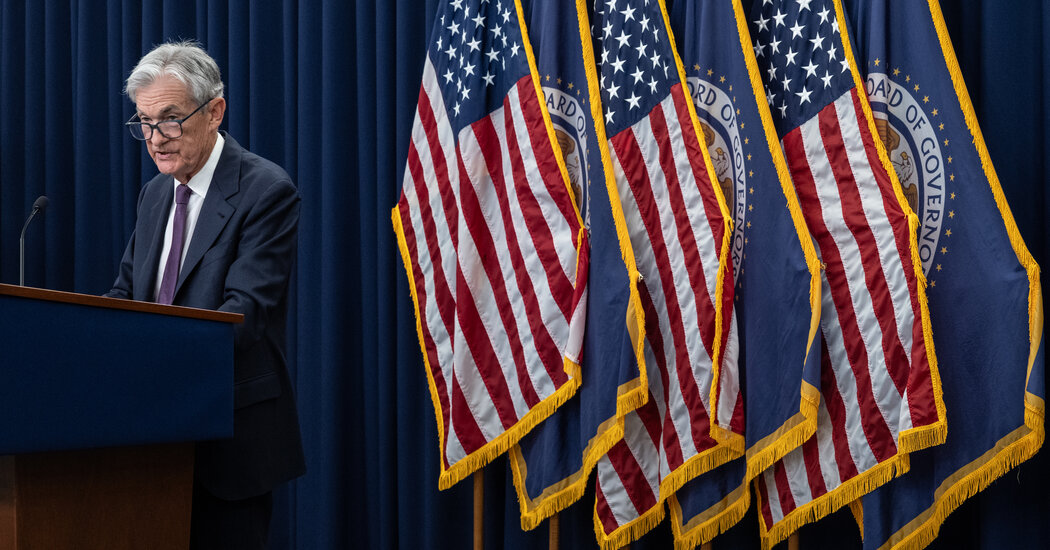
Jerome H. Powell ended his eight-year term as Federal Reserve chairman with the most contentious policy meeting in decades, as three officials suggested the central bank should signal more directly that the Fed’s next move could be just as likely to be a rate hike as a rate cut.
Adding to the drama was Mr. Powell’s announcement that he would remain governor of the central bank after his term as chairman ends on May 15 and President Trump’s hand-picked successor, Kevin M. Warsh, takes over. That decision will deny Mr. Trump the opportunity to appoint another governor to the Fed’s seven-member board until Mr. Powell leaves.
Mr. Powell’s decision to stay, which he can do until January 2028, breaks with tradition. But he attributed that to the numerous broadsides that Mr. Trump and his administration have launched against the Fed over the last year, which he warned would “jeopardize” the central bank’s independence.
Wednesday’s meeting, at which the Fed voted to keep interest rates unchanged in a range of 3.5 percent to 3.75 percent, highlighted the acute challenges that Mr. Warsh will take on once he assumes the role. In his confirmation hearing, Mr. Warsh said he wanted more “chaotic” meetings and a good “family feud” from the Fed, which he was likely to get.
But he also risks becoming Mr. Trump’s latest target if he fails to push through the rate cuts the president has long demanded. The president has spent years attacking Mr. Powell for not cutting interest rates quickly or aggressively enough, calling him a variety of epithets including “too late,” “a stupid person” and an “idiot.”
Mr. Trump reiterated on Wednesday that it was a “good time” to cut interest rates, just as Fed officials made clear they had become more cautious about granting that relief. Within the central bank, the debate has shifted from when to cut again to whether to do so at all, leading to the most contentious meeting since 1992. The calculation has changed largely because of the war in Iran, which has driven up energy prices and increased inflation.
Stephen I. Miran, who was appointed to the Fed by Trump last year, voiced his sixth consecutive dissent and voted for a quarter-point cut. The presidents of three regional reserve banks supported the decision to keep interest rates stable. However, they wanted the Fed to be clearer in its policy statement that the central bank’s next move is not necessarily another rate cut.
Instead, the Fed insisted in its statement that “the Committee will carefully consider the incoming data, the evolving outlook, and the balance of risks in considering the magnitude and timing of additional adjustments to the target range for the federal funds rate.”
The disagreement came from Beth Hammack, president of the Cleveland Fed; Lorie Logan, who runs the Dallas Fed; and Neel Kashkari, who heads the Minneapolis Fed.
A growing number of officials fear that the longer the war with Iran drags on, the greater the economic impact will be. Officials fear a situation in which higher energy prices push up prices elsewhere, particularly in the services sector, creating a more persistent inflation problem that would be harder to solve.
Expectations for future inflation suggest that Americans have not lost faith in the Fed’s ability to eventually bring inflation back down to its 2 percent target. But the emergence of another shock that has pushed inflation further away from the Fed’s target – the fourth in five years – will undoubtedly test that confidence.
On Wednesday, Mr. Powell said the Fed would have to be “very cautious” in assuming that the trajectory of oil prices will not have a more lasting impact on inflation. However, he made it clear that no one at the Fed is currently calling for a rate hike.
While Powell remains governor, he will still be able to vote on monetary policy, although he said he would keep a “low profile” to ensure the smoothest possible transition for Mr. Warsh and allow him to build consensus on his views within the Fed.
“I propose to be a very constructive participant in this process, really out of respect for the office of the chair,” Powell said. He praised Mr. Warsh for having the “skills” to build consensus within the Fed.
Policy decisions are made by a twelve-member committee that also includes the six other members of the Board of Governors, the president of the Federal Reserve Bank of New York, and a rotating group of four presidents of the twelve regional banks.
Mr Powell’s decision to remain in office was immediately attacked by the government. Scott Bessent, the Treasury secretary, told Fox Business that it was a “highly unusual” move and a “violation of all Federal Reserve norms.” He added that it was an “insult” to Mr Warsh.
The White House did not immediately comment on Mr. Powell’s decision to stay, but there will undoubtedly be further conflict with the president, who has vowed to fire Mr. Powell if he does not resign from the Fed when his term as chairman expires.
Mr. Trump said in a social media post that Mr. Powell was staying at the Fed because “he can’t get a job anywhere else.”
A president can only remove an official if there is “cause,” which usually means gross misconduct or dereliction of duty. Mr. Trump tried just that with Lisa D. Cook, a governor he accused of mortgage fraud before joining the Fed. The Supreme Court is currently debating their challenge to the president’s claim.
Mr. Powell did not say how long he would stay as governor, but made clear that his decision would depend on the outcome of a Justice Department criminal investigation into cost overruns on renovations at the central bank’s headquarters in Washington and whether he lied to Congress about it.
The investigation led to a rare public rebuke from Mr. Powell, who said it was a coercive tool to get the Fed to comply with the president’s demands for lower interest rates. Mr Powell had previously said he would not leave the Fed until the investigation was completed “clearly, with transparency and finality”, a condition he reiterated on Wednesday.
The Justice Department ended its investigation on Friday, but left open the possibility of a reopening. Federal prosecutors may also appeal a federal judge’s recent ruling that overturned subpoenas to the central bank.
Senator Thom Tillis of North Carolina, a leading Republican who had held up Mr. Warsh’s confirmation because of the investigation, suggested that any appeal would not be about prosecuting Mr. Powell but about defending prosecutors’ power to issue subpoenas. But an appointment would only encourage Mr. Powell to stay in office longer.
Mr Powell stressed that the legal threats against him and the institution were not over. “I will leave when I think it is appropriate,” he said.
“I am really concerned about the series of legal attacks on the Fed that have threatened our ability to conduct monetary policy without considering political factors,” Powell said. “I worry that these attacks are damaging to the institution.”