


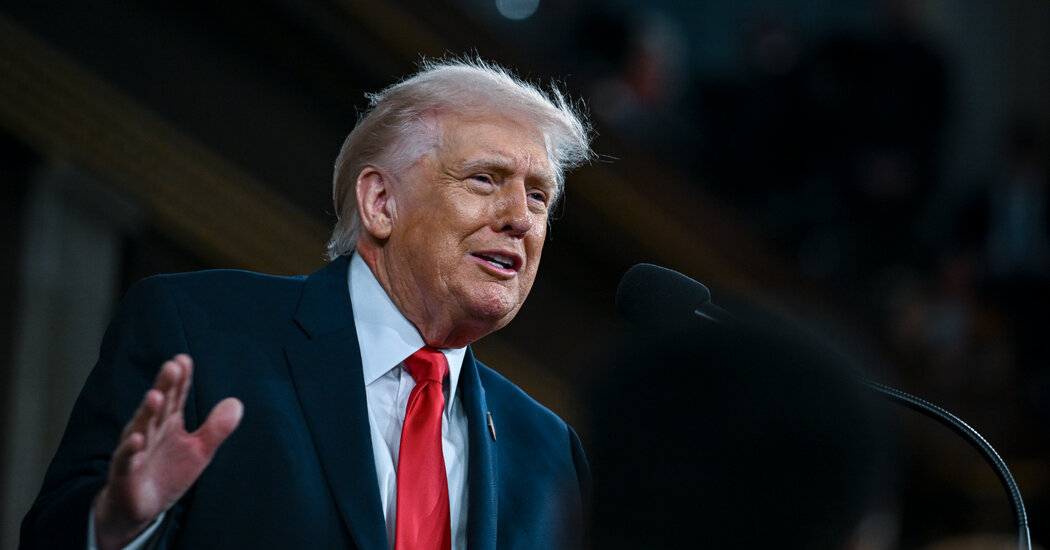
President Trump signed an executive order on Thursday designed to make it easier for millions of workers without access to corporate retirement plans to find and open an individual retirement account through a federal platform. It’s the latest attempt to address a problem that has plagued American savers for generations.
The order does not create new retirement accounts, but rather directs individuals to “low-cost” IRAs offered by private companies through a new website called TrumpIRA.gov, which President Trump has ordered the Treasury Department to create by January. The website allows employees to filter and compare IRAs based on cost, quality and investment options.
The effort would also make it easier to access a new federal match, called the Saver’s Match, that goes into effect next year and is aimed at lower- and middle-income workers.
However, details about exactly how this would all work or which companies would be involved have not yet been revealed.
For decades, closing the gap between those with and without workplace plans has been a bipartisan goal of policymakers. According to a study by the AARP Public Policy Institute, nearly half of private sector workers, or about 56 million people, do not have access to corporate retirement accounts or traditional pensions. Most of them are low- or middle-income or work for small companies that don’t offer retirement plans.
“My administration intends to give these often-left-out American workers access to the same retirement savings opportunities offered to every federal employee,” Trump said in the executive order. He was referring to the Thrift Savings Plan, the retirement program for federal employees that offers low fees and a small collection of index-like investments.
Mr. Trump also called on Congress to pass legislation to codify and further develop the website framework.
“Treasury’s directive to make it easier for workers without employer plans to find low-cost private sector IRA options — and to promote the “saver match” — reflects the kind of practical, market-oriented thinking that has garnered bipartisan support in the past,” said Emerson Sprick, director of retirement and employment policy at the Bipartisan Policy Center, a centrist think tank.
The effort would integrate an existing federal equalization contribution, at least for workers who earn below a certain income limit. This “savings grant,” which President Joseph R. Biden Jr. signed into law in 2022 and takes effect next year, covers up to 50 percent of a worker’s contribution, capped at $1,000 for individuals and $2,000 for couples. (To get the maximum match of $1,000, you would need to save $2,000 – if you save less, you will get proportionately less.)
According to Pew Charitable Trusts, a nonprofit public policy organization, individuals must earn less than $35,500 to qualify for a full or partial match. For married couples, the limit is $71,000.
The match formula and deployment aren’t quite as straightforward as traditional workplace 401(k) plans. This comes in the form of a refundable tax credit, meaning you would receive the money even if you didn’t owe much (or any) in taxes to the federal government. The money would go directly into a retirement plan. And many people who qualify for a match aren’t eligible for the full amount – your adjusted gross income determines both whether you qualify and the amount.
The implementing regulation clarifies that participating financial institutions must offer low-cost investments and meet other criteria. For example, requiring minimum balances is not permitted and total investment costs must be limited to 0.15 percent of an employee’s account balance.
Institutions should also offer funds designed to protect the investor’s primary investment, as well as target date funds, which are a mix of stock and bond funds that automatically become more conservative as a worker’s target retirement date approaches.
The White House also appears poised to allow charitable donations into the accounts of eligible workers, perhaps similar to the Dell family’s plans to make donations into Trump accounts, a new type of investment account for children.
There are also efforts to make these efforts permanent; The order directs Congress to establish a “permanent pathway” for Americans to have access to low-cost investment accounts and a federal matching program.
There is already at least one such bipartisan bill in both chambers: the Retirement Savings for Americans Act, introduced by two pairs of Republicans and Democrats in the House and Senate. This proposal is based on the work of Teresa Ghilarducci, a labor economist and long-time supporter of universal retirement accounts, and Kevin Hassett, one of Mr. Trump’s top economic advisers and director of the National Economic Council.
The legislation gives eligible workers access to portable, tax-deferred retirement accounts and allows more households to qualify for the federal subsidy, which would instead expire once they reach median income, which was $83,730 in 2024, according to the Census Bureau.
“This is a huge relief,” said Ms. Ghilarducci, who is also director of the Wealth Equity Center at the New School for Social Research. “The American pension system failed because we expected employers to voluntarily cover everyone, and it took more than four decades for us to realize that that simply wasn’t going to happen.”
This is not the first time that the federal government has tried to strengthen pension provision. In 2015, President Barack Obama created starter retirement savings accounts called myRA accounts. The first Trump administration halted these efforts in 2017.
States have also tried to help private sector workers. According to Pew, about 17 states have passed laws establishing automated individual retirement accounts, where employers help their employees save through automatic payroll deductions. However, employers generally do not monitor the accounts – they are managed by a financial services company approved by the states.
Ron Lieber contributed reporting.