


Kevin and Motomi Kudo-King are architectural enthusiasts. They met in 1996, shortly after graduating from college, as interns in the Seattle studio of the Olson Kundig architectural firm.
They married in 1998 and never left Olson Kundig. Mr Kudo-King, 56, is now managing director and owner of the company. Ms Kudo-King, 53, works part-time as a senior executive after reducing her working hours to raise the couple’s two children, now aged 19 and 15.
“But we applied for a job and Motomi got the job,” Mr. Kudo-King said when they had just started. “She always reminds me of that.”
But after more than two decades of almost continuous discussions about architecture, in the office and at home, they were still missing one thing: the experience of living in a house of their own design.
They lived for many years in a 1912 bungalow in Seattle’s Greenwood neighborhood, which they modernized while being careful to preserve its character. “We really liked the bungalow and stayed true to what the bungalow was,” Mr. Kudo-King said, including keeping the interior walls that divided it into a series of compact rooms.
But at some point they realized they wanted something different. “We really wanted an open kitchen and the opportunity to socialize, invite friends and cook together,” Mr Kudo-King said. They also wanted the opportunity to create a home that reflected their personality and the nature of their work at Olson Kundig.
Additionally, they felt that their home should express their shared interest in Japanese architecture and design. Ms. Kudo-King was born and raised in Japan, and she and Mr. Kudo-King often visit family there, where they admire everything from the traditional architecture of Kyoto to contemporary buildings by architects such as Kengo Kuma.
In 2013, they decided it was time for a change and bought a one-story, flat-roofed 1950s modern home in the nearby town of Shoreline for $723,000.
“There was a stream at the bottom of the hill and a dramatic steep slope that dropped away,” said Mr. Kudo-King, which offered beautiful views of the forest. But the house itself wasn’t particularly remarkable and they were confident they could improve the design.
“It wasn’t that pure,” Ms. Kudo-King said. “We could imagine adding something else.”
After the closing, the couple moved in and immediately began drawing up plans for a renovation and addition. But with their tasks always taking precedence, it took almost nine years before they decided to construct a final design.
“It fell apart while we lived in it,” Ms. Kudo-King said. “The roof once leaked and we had pots and pans on our bed.”
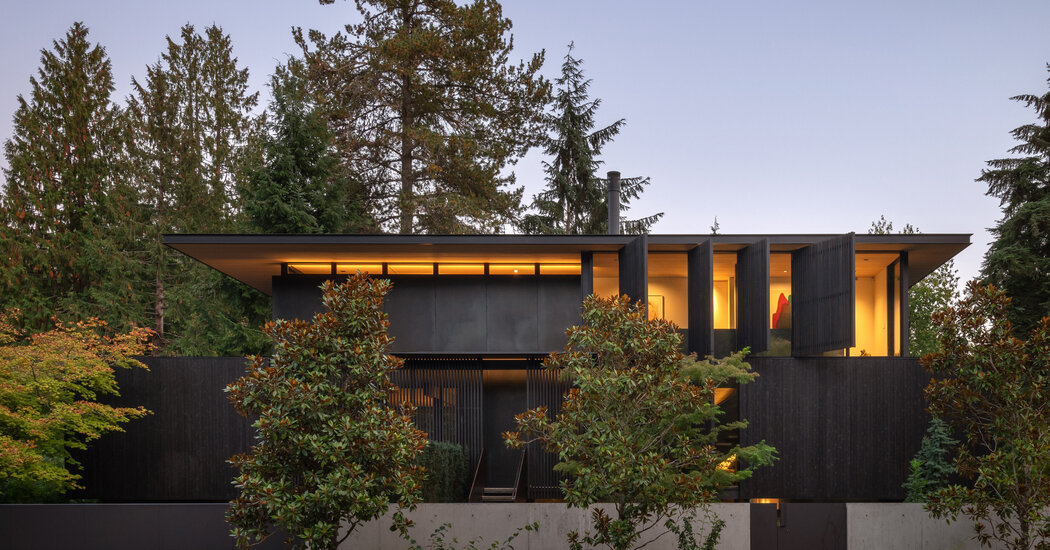
But in 2022, they moved out so their contractor, Dolan Construction, could begin work. The couple’s new design reconfigured the original 2,254-square-foot structure, which was a wood-and-glass box perched on a concrete block foundation, and added a new second story, increasing the total footprint to 3,571 square feet.
The structure is topped by a new flat roof with wide overhangs and is clad in raw pine tar-blackened cedar and clear-coated steel. Most of the cedar wood is used for huge outdoor screens that run over the windows, but are equipped with hinges and a motor so they can be opened when necessary.
The couple relocated and enlarged the front entrance by hiding a nearly 18-foot-tall Dutch door on one side of the house behind a cedar wall. The steel door, painted with khaki car paint, is intended to be both a surprise and a personal touch: When the couple got married, they gave guests khaki-colored Japanese lacquer bowls. The top portion of the door, which is five feet high, can be opened for ventilation on warm days.
“We wanted it to be dramatic but hidden,” Mr. Kudo-King said. “You can’t see it if you look directly at the house or come through the gate. It’s something you turn around and discover.”
Inside, they created the open floor plan they had long wanted, with a kitchen with a long island topped with flamed and brushed black granite next to a dining area centered on a table with a walnut top and steel legs that Mr. Kudo-King welded himself. On one wall is a tansu chest that once belonged to Ms. Kudo-King’s grandmother, while on another is a favorite piece of art by Etsuko Ichikawa, created by burning paper with molten glass.
From the adjacent living room, a steel staircase with open risers that provides a view of a Japanese maple tree outside leads to the second floor. There, the master bedroom juts out toward the treetops and ends there with a wall of sliding glass doors that can open the room to nature.
The couple moved back into the home in September 2024, although contractors continued to work on finalizing the details for several months. The cost of the transformation was approximately $3.75 million.
After more than a decade of planning, designing and building, the architects now have a home that feels like them.
“It is often said that every architect should build their own house,” Ms. Kudo-King said. “We did it. And we survived.”