


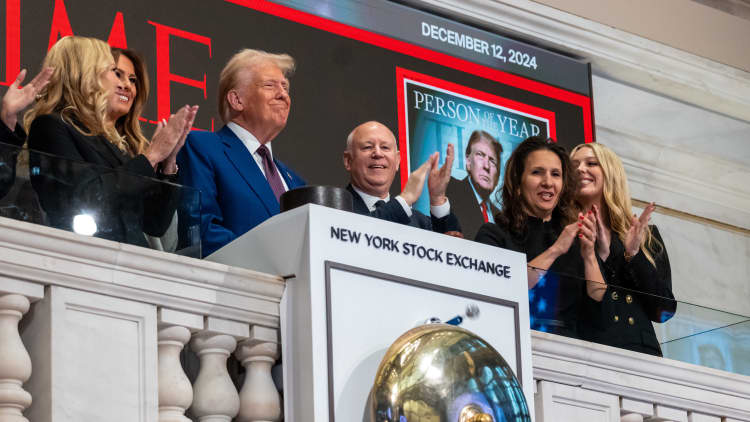
President Donald Trump is considered the ultimate stock market president, driving shares to numerous record highs while also acting as a catalyst for major price declines.
Within the first two months of Trump’s second term, the S&P 500 experienced one of the fastest declines into correction territory since World War II, driven largely by uncertainty over its tariff policies. Less than a month later, the index closed almost in a bear market after the president’s “Liberation Day” tariff announcement. A correction is defined as a decline of at least 10% but less than 20% from the recent peak, while a bear market is a decline of at least 20% or more on a closing basis.
But even under Trump, the market recovered faster than usual.
According to CFRA Research, the two S&P 500 declines that have occurred since the start of 2025 have reversed by 5% to 9.9% faster than the 34-day average. That’s a better recovery rate than under any president since Ronald Reagan in 1981.
“The bull market takes the stairs while bear markets take the elevator,” said Sam Stovall, chief investment strategist at CFRA Research. “What we are seeing in Trump 2.0 is lower volatility overall, combined with faster-than-average recovery from sharp sell-offs.”
The recent recovery in Trump’s second term – when the S&P 500 recovered from a 9.1% decline in just 16 calendar days – was one of the fastest since World War II, ranking ninth fastest, according to CFRA.
“It is the earnings growth that has kept investors very optimistic,” Stovall said.
A new era
FactSet data shows S&P 500 earnings rose more than 20% year over year in the first quarter. This is almost the strongest profit increase since the fourth quarter of 2021.
This solid earnings environment – which underpinned the high level of enthusiasm for artificial intelligence on the Street – may have supported the market’s recent rally. However, the uptrend was initially triggered by hopes that the war between the US and Iran would end in the near future.
Iran and the United States agreed to a ceasefire last month, easing fears that oil prices would remain high and put upward pressure on prices. But that truce has become increasingly fragile, with Trump saying this week that the truce was “on life support.”
“News is more important than charts,” said Ryan Detrick, chief market strategist at Carson Group. “We were in a very headline-driven world, a headline-driven market, and investors just had to buckle up, get on the roller coaster ride and get on board.”
Detrick maintains that there is still a global bull market in stocks, and it may be on the younger side of its lifespan. From here, he says, investors would be best advised to buy on dips.
“I don’t know that we’ve ever had a market that was so fixated on the daily news coming out of the White House,” he said. “Under President Trump, I think we’re going to have to get used to that volatility.”
This indicates a generational change on Wall Street. In recent years, investors have been conditioned to use significant market declines as buying opportunities, particularly those that came of age in the wake of the global financial crisis.
“FOMO is a very real thing for an institutional investor,” said Steve Sosnick, chief strategist at Interactive Brokers.
Sosnick found that those who sold Trump’s tariff announcement last year and were slow to buy back shares performed worse than those who didn’t. This has now led to “this general reluctance of institutions to sell too aggressively,” he said.
“Maybe we’re leaving a little too much behind us or relying a little too much on the government’s happy words,” the strategist told CNBC.
“Don’t fight the White House”
Investors were so focused on announcements from the White House that Trump was the main driver of the best — and worst — five days since returning to office, Fundstrat data shows.
The S&P 500’s best day since Trump became president again was April 9, 2025 – when it rose more than 9% after he suspended his widespread tariffs. The benchmark’s worst day occurred on April 4, 2025, after China retaliated with its own levies on U.S. goods.
According to Fundstrat, no U.S. president in nearly half a century has been responsible for so many best and worst market days during his time in office. Without Trump’s five best days in his second term, the S&P 500 would have risen just 1% since he took office. In contrast, the index is up 23.5% since the opening date.
“No other president has had this level of control over the fortunes of the stock market,” Hardika Singh, economic strategist at Fundstrat Global Advisors, said in an interview.
“The only strategy investors need to adopt is not to fight the White House, otherwise you will lose and you won’t make money,” she said. “Throw away your old investment book.”
Trump’s communication style, at times quick posts on social media, has further fueled market volatility – and changed the way future presidents must deliver messages to Wall Street, said Matt Gertken, chief geopolitical strategist at BCA Research.
“Social media is now kind of the be-all and end-all,” said Gertken. “Even a president who arrives and tries to establish a very robust and routine method of communication may have to later adopt some of Trump’s standards because of the situation he finds himself in.”
Regardless of whether future presidents actually adopt a Trumpian communication style, the market will remain volatile. For Gertken, if future presidents become more silent on social media, the market will “ebb and flow on speculation.” But if they talk like Trump frequently, the market will fluctuate based on their recent statements.
“There is no turning back,” he said.
Choose CNBC as your preferred source on Google and never miss a moment from the most trusted name in business news.