


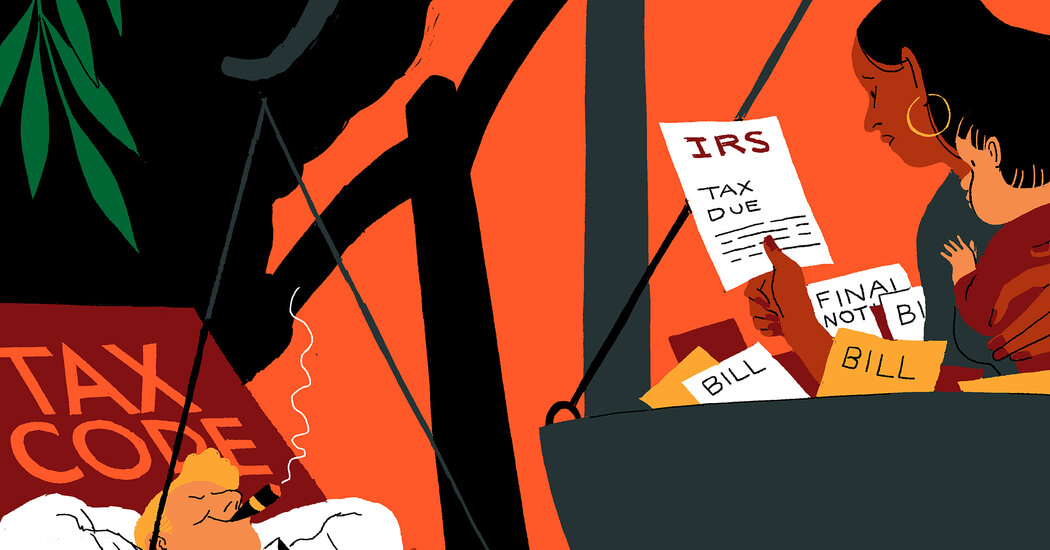
For many Americans, taxes are a chore that they have to do once a year. But if you think about the tax code long enough, you might start to see it differently—as a reflection of values or even as a national anthem. In some places it may also sound anti-feminist.
Bridget J. Crawford, a professor at the Elisabeth Haub School of Law at Pace University, has analyzed the tax code from all of these perspectives in her academic work, with one sentence coming up again and again: The tax code is not neutral.
She has long believed that this reinforces power imbalances, particularly gender inequality, which led her and a colleague to explore a question: What would the tax code look like if it were reimagined through a feminist framework?
Professor Crawford and Anthony C. Infanti, her co-author and law professor, published a book several years ago in which a group of experts reformulated tax-related court decisions using this filter, using the law as it existed at the time the cases were decided.
But they had a broader view of feminism. “It certainly has its historical roots in the feminist movement and women’s rights, but our version is much broader – and it’s for everyone,” Professor Crawford said. “Feminism, at its core, is the effort to ensure that our legal and economic systems enable everyone to live with equal dignity, autonomy and economic security.”
The tax code underwent another round of overhauls as part of the sweeping tax and policy legislation — the One Big Beautiful Bill Act — that Congress passed last summer.
With tax season just around the corner, we asked Professor Crawford to reflect on today’s tax landscape and what she would rewrite if she had the chance.
This interview has been edited and condensed for clarity.
What is the most anti-feminist thing about our tax code?
Tax law often assumes that economic resources are distributed equally within a household and that care has no independent economic value. Both assumptions obscure the reality of inequality and disproportionately disadvantage women.
For example, childcare or perhaps an aging parent.
Child care must be a priority. The child and dependent care tax credit covers only a small portion of actual child care costs and is being phased out for middle- and upper-income households. So it neither fully supports the poor nor provides real incentives for the participation of professionals who must balance high care costs and high taxes.
The fact that childcare is treated as a personal expense rather than a work-related necessity is a major problem.
Unpaid carers do not contribute to social security and other tax-related benefits, leading to longer-term economic inequalities.
We understand that some married couples may apply jointly punished and pay more taxes than they would pay individually, while other couples benefit from a marriage bonus and pay less. Is there a better way?
There is no perfect system. Joint taxation can benefit some couples and disadvantage others, depending on how income is distributed between spouses.
In dual-earner households, the second income is often taxed at a higher marginal rate. Historically, this is more likely to be the wife than the husband, and the higher tax rate can negatively impact their labor force participation. So for me there is a good argument that the joint return itself hinders women’s employment and reinforces traditional gender roles.
However, individual taxation has the advantage of neutrality: it avoids rewarding or punishing individuals based on their marital status and treats each taxpayer as economically independent.
The American tax code is at least partially progressive in that higher income is taxed at higher rates. However, in practice there are many regressive features. Warren Buffett famously said it paid a lower rate as his secretary. That seems pretty anti-feminist.
The gap between tax rates on labor and tax rates on capital is one of the key drivers of inequality. Gender inequality and wealth inequality are closely intertwined. So when tax law privileges capital, it often indirectly favors men. Feminist tax analysis helps to make these structural effects visible.
Also clearly visible: the growth the billionaire class. They can have outsized influence and power over electoral politics and policymaking. What role does the tax code play in wealth concentration?
The tax code makes it easier to build and maintain wealth than to earn a living through work. This structural decision has profound consequences for inequality.
Was there a time when the tax code was fairer? It probably wasn’t more feminist, at least in the traditional sense.
The tax system of the mid-20th century did more to limit extreme wealth, even if it did not fully address gender inequality. Progressiveness alone is not enough, but it is an important foundation for justice. The inheritance tax once reflected a democratic commitment to preventing permanent economic aristocracies. Its decline means we have embraced the inequalities of a new Gilded Age.
What is the impact of the comprehensive tax law passed last summer – and some of it is taking effect? current tax season (for the tax year 2025) – fit into the overall picture?
I think it’s the ultimate example of technocratic changes providing a veil over what’s really going on. And what’s really going on is continued tax breaks for the wealthy, minor reforms at the margins for people like tipped workers, but extraordinary cruelty toward families and people living in poverty.
If you could rewrite a part (or parts) of the tax code, what would you change?
Tax law is not just about generating revenue. It communicates whose work and whose life the law values. A feminist tax law would pay attention to how tax regulations affect economic independence, care, and bodily autonomy. We must stop favoring wealth over work.