


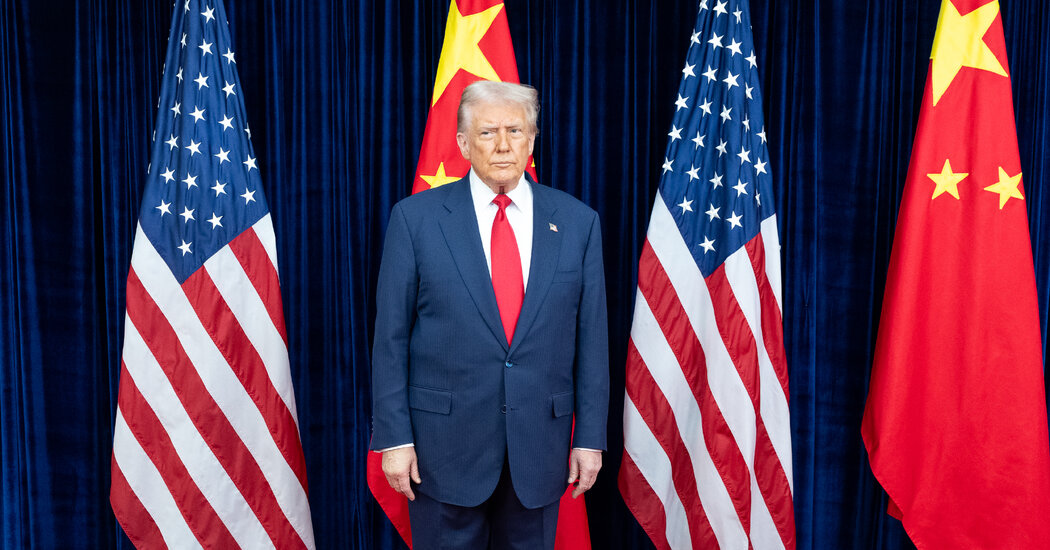
When President Trump campaigned in 2024, he promised a trade agenda that would hit China harder than any other economic partner, building on the actions he took in his first term.
Mr. Trump spoke of imposing a tariff of 60 percent or more on the country and suggested stripping China of the preferential trading relationships it gained when it joined the World Trade Organization. Tariffs would also be imposed for the rest of the world, but at significantly lower rates of 10 or 20 percent.
More than a year into Mr. Trump’s first term, the picture looks dramatically different. Although U.S. tariffs against China are higher overall when tariffs from Trump’s first term are included, other countries faced tariffs that were almost as high and even higher for some products.
The Trump administration has saved its harsh criticism for its allies in Europe and Canada while taking a more cautious approach toward China. And with Trump traveling to Beijing this week for a summit with Chinese leader Xi Jinping, expectations of its outcomes are limited.
Rather than pressuring China to make broader structural changes to its economy, as Mr. Trump’s advisers did in his first term, the focus is now largely on maintaining stable relations between the countries while restoring or increasing U.S. sales of products such as aircraft, ethanol, soybeans, beef and sorghum.
The remarkable decline in Mr. Trump’s Chinese ambitions is the result of last year’s events, when China responded to Mr. Trump’s tariffs by cutting off supplies of rare earth minerals and magnets needed by American companies that made everything from cars and weapons to power tools.
Facing the prospect of shuttered U.S. factories and widespread economic damage, the Trump administration appears to have abandoned the idea of a more ambitious deal with China — widely seen as America’s most problematic trading partner — even as it pressures less problematic partners more aggressively than ever before.
Myron Brilliant, senior adviser at the DGA-Albright Stonebridge Group, a consulting firm, said this week’s summit in Beijing will be “heavy on strategic distrust and high on symbolism, but low on ambition.” The past year has been a turbulent time for U.S.-China relations, he said, and both sides “are now managing risk.”
“Each side seeks stability and the results will be predominantly short-term,” he said. Mr. Brilliant said the results could include agricultural and aircraft purchases as well as agreements to curb fentanyl exports.
U.S. officials have discussed creating a new “trade committee” to oversee the agreed purchases, which could amount to tens of billions of dollars. Others have suggested the meeting could lead to lower tariffs on more common products to boost their sales.
While Mr. Trump’s global tariffs have been repeatedly overturned by the courts, the administration is preparing two new trade investigations that are likely to result in further levies against dozens of countries, including China, this summer. Chinese officials are expected to press U.S. officials to keep those tariffs low.
Analysts said Chinese officials would also likely push for a loosening of U.S. technology controls or a change in U.S. stance toward Taiwan, a self-governing island that China claims as its own.
Kurt Campbell, a former U.S. deputy secretary of state, said the Chinese side would try wherever possible to get the United States to back down on economic measures such as tariffs. But the most important priority for China is getting Mr. Trump to deviate from traditional approaches on Taiwan.
“If there are deals about large purchases of agricultural or beef products, pork or Boeing by the Chinese, they will expect something in return,” he said.
U.S. officials have said they do not expect any changes to Taiwan policy. In a briefing with reporters on Sunday, Anna Kelly, a White House spokeswoman, said Mr. Trump had focused the U.S.-China relationship “on what matters most: restoring the security and prosperity of Americans.”
“On this visit, President Trump will continue to do what he has done over the past year: rebalance relations with China and emphasize reciprocity and fairness to restore America’s economic independence,” she said.
Despite Mr. Trump’s aggressive statements during the campaign, his advisers say his goal was never a decisive decoupling from China. Instead, he envisioned his trade threats as a way to pressure Beijing into a larger trade deal that would tip the balance in the relationship in favor of the U.S. economy and help secure global peace.
The problem was the execution. When Mr. Trump tried to force concessions from China last year by threatening extreme tariffs, the tactic backfired and forced the U.S. to scale back its targets.
“They have taken steps to be more aggressive toward China,” Mary Lovely, a senior fellow at the Peterson Institute for International Economics, said of U.S. officials. “What happened was that China decided to invoke its own key bottlenecks and counter the U.S. in a way it hadn’t done before.”
“I have no idea why they didn’t expect this,” she added.
As the situation escalated again last fall, senior officials including Treasury Secretary Scott Bessent and Trade Representative Jamieson Greer compiled a list of measures they could take to push back, including restrictions on things like software, semiconductor manufacturing equipment and visas that could force Beijing to back down.
But before a meeting with Mr. Xi in South Korea in October, the president urged his advisers to push for a ceasefire instead. In the end, the United States shelved a series of measures against China, including a delay in imposing a sweeping technology restriction that would affect Chinese companies and new fees on Chinese ships aimed at building the U.S. shipbuilding industry.
In recent months, the United States and China have maintained a temporary ceasefire. Many exports of Chinese rare earths to companies not affiliated with the military have resumed, although U.S. companies remain gravely concerned about their longer-term access to the minerals. The government has taken steps to try to increase the domestic supply of rare earths, including building a stockpile of critical minerals, but U.S. industry remains heavily dependent on China for materials that will be critical to the U.S. economy in the future.
After Mr. Trump met Mr. Xi in South Korea, both sides spoke enthusiastically about meetings between the leaders the following year. A meeting was planned for April but was postponed to May due to the Iran conflict.
Christopher Padilla, a former trade official in the George W. Bush administration, agreed that there probably wouldn’t be “many big results.” He added: “They’ll agree to let us buy some of it, they’ll buy some of it, and then they’ll have a party and call it a day.”
U.S. officials say their talks will lead to a fairer trading relationship with China, arguing they still have an advantage. But the Chinese government appears more determined than ever to gradually counteract any offensive US measures that could be extremely damaging to the US economy.
China has issued regulations in recent months to investigate and punish foreign companies that stop working with Chinese suppliers under foreign pressure. And after the United States punished several Chinese refineries for buying Iranian oil, the Chinese government took the unorthodox step of ordering its companies not to comply with the sanctions.
Ms. Lovely, of the Peterson Institute, said China has been providing the legal basis for anti-foreign sanctions measures for a decade. “Now they feel confident enough to use them,” she said.