


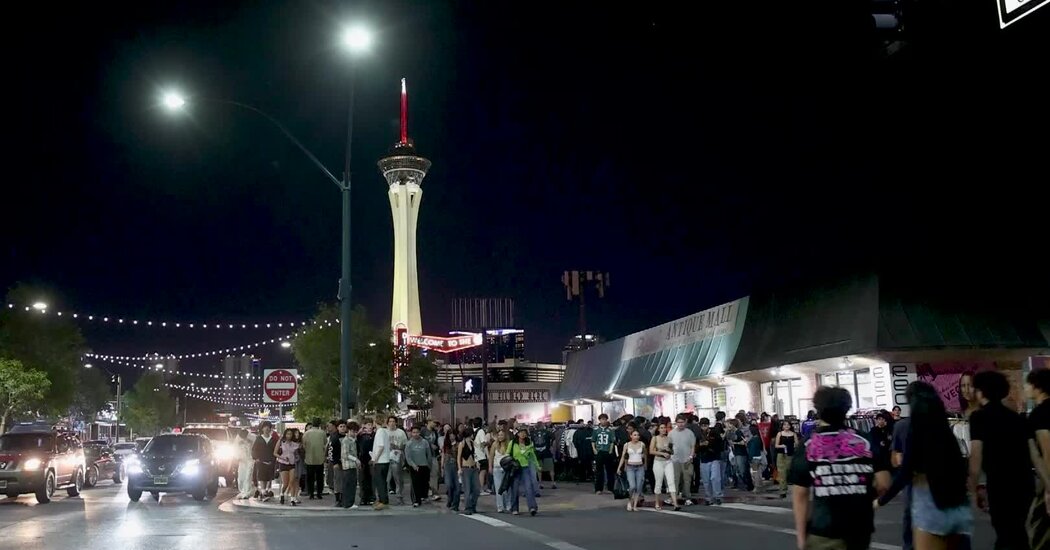
It’s tempting to define the Las Vegas Arts District, a 22-block former industrial district about a mile north of the Strip, as a counterpart to the rest of the southwest metropolis, with its glitzy casinos and acres of manicured suburbs.
And you’re right: This tiny, walkable, artist-built enclave—about half a mile wide, a mile long, and dotted with colorful murals—has its own captivating energy.
“It’s a hodgepodge and a patchwork, a mix of new and old things that have somehow merged into a really cool place,” said Izaac Zevalking, an artist who grew up in the United Kingdom and opened the Recycled Propaganda gallery here in 2018.
Location: A 22-block cultural district in downtown Las Vegas, north of the Strip and tucked between Interstate 15 and busy South Las Vegas Boulevard.
Area: 131 acres or about 0.2 square miles
Population: By 2026, only a few thousand lived in the area, local real estate agents estimate. 42,465 live in downtown Las Vegas (2020 U.S. Census Bureau estimates).
Housing: 19% home ownership in downtown Las Vegas (2020 U.S. Census Bureau estimates).
The mood: Arty, cool, dark, young, with a focus on nightlife and rentals in new and converted buildings.
Attracted by low rents (and a well-stocked, long-established art supply store), photographers, painters and sculptors came to the district to work and live in the early 1990s. Today, many of the mid-century low-rise commercial buildings have been converted into rows of art galleries, shops, performing arts clubs, and an increasingly sophisticated selection of bars, coffeehouses, breweries, and restaurants. “It’s become a weekend hotspot,” Mr. Zevalking said, although it’s still rough around the edges.
Designated a cultural district by the city in 1998, the Arts District is technically a small part of the city’s historic downtown, tucked between Interstate 15 and busy South Las Vegas Boulevard.
In the past, there were few residents in the area, Mr. Zevalking said, mostly because there weren’t many real homes there. But that is changing quickly.
This spring, more than 600 apartments will open in two new high-quality residential properties. The Myles, a five-story complex, is located in the southwest corner of the neighborhood. On the eastern edge is Gemma, whose three seven-story buildings have ground floor retail space. According to the city of Las Vegas, two more buildings with several hundred more apartments are currently in the works.
These follow several new downtown housing developments that have opened north of the Arts District. Juana Jimenez, a Las Vegas native, lives there. But Ms. Jimenez, assistant manager of the company that developed Gemma, prefers to stay in the Arts District. She said the small-town feel is distinctive in Las Vegas. Everyone who works or lives here knows everyone, she added.
In many ways, today’s Arts District is similar to Miami’s Wynwood Arts District or Brooklyn’s Williamsburg Waterfront in its early days. Both were once industrial, arts-focused communities that have become some of their cities’ most desirable (and crowded) places to live and visit.
These are also places where existing residents are still debating the changes (and worried about higher costs of living) that come with each new phase of growth. Josh Kellman, the president of the 18b Arts District, a nonprofit neighborhood association, is one of the people currently leading these discussions. (The Arts District was originally 18 blocks in size and is still referred to as “18b” by locals.)
Most members of the organization are looking forward to new residents, Mr. Kellman said. They invest more in the community as visitors, spend money locally and could spur the emergence of much-needed housing facilities such as a supermarket, Mr Kellman said.
The city also helps drive the region’s growth, he said. Recently, residents and business owners were surveyed about their needs and concerns. These included the challenges of living in an area with a high homeless population and a lack of parking. Not surprisingly, the biggest concern is housing affordability, Mr. Kellman said. “We don’t want to price out artists who want to live here,” he said.
With that in mind, the city is seeking proposals from developers to convert a 1.23-acre vacant lot it owns into affordable housing and studio space for local artists.
Mr. Kellman moved to this area with his family from a Las Vegas suburb five years ago, in part to live in the city’s historic core. Like most people who live or work here, he wants to ensure that the district’s distinctive character is preserved.
This includes the mid-century commercial architecture, the artists who were originally drawn to it, and the nightlife that followed – such as the long-running chaos of a First Friday street party and streets full of bars.
“We’re a little loud,” Mr. Kellman said.