


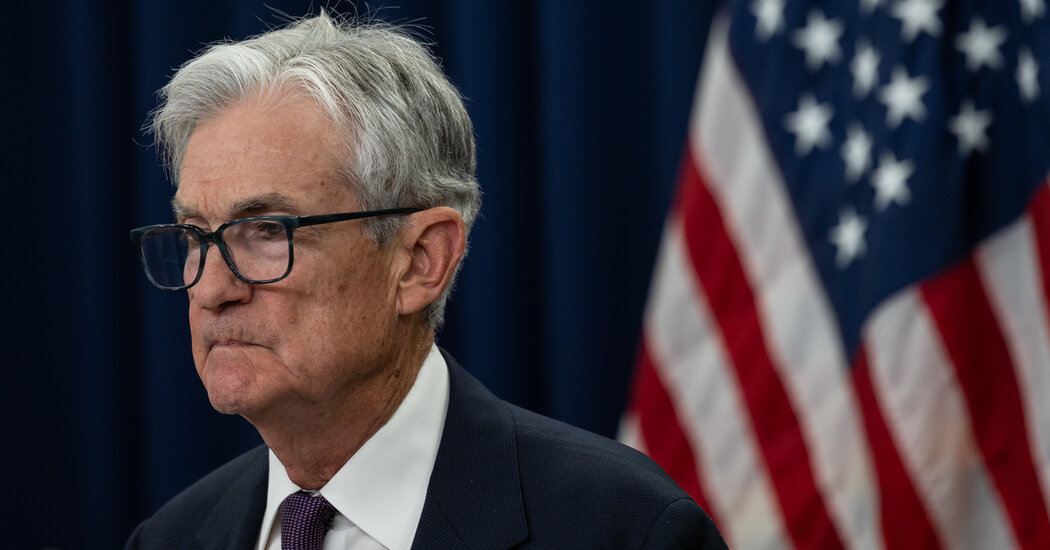
A majority of Federal Reserve officials expected higher interest rates may be necessary to combat resurgent inflation, according to minutes from the central bank’s April meeting.
Minutes from the latest meeting released Wednesday highlighted the extent to which the war with Iran has upended the economic outlook and policy options of a central bank on the cusp of a leadership change. The April meeting was Jerome H. Powell’s last as chairman. His successor Kevin M. Warsh is scheduled to be sworn in at the White House on Friday.
Heading into 2026, most Fed officials saw a path to lower interest rates this year, expecting inflation to slow as the impact of President Trump’s tariffs faded.
But the war-induced energy shock has pushed inflation further away from the Fed’s 2 percent target and raised concerns about a more persistent problem just as the labor market has stabilized. This backdrop has clouded the prospects for immediate relief on borrowing costs, with traders in federal funds futures markets now expecting a rate hike in early 2027.
According to the minutes, a majority of participants emphasized that “some policy tightening would likely be appropriate if inflation continued to rise above 2 percent on a sustained basis.”
The April meeting was one of the most contentious in decades. Most policymakers agreed with the Fed’s decision to keep interest rates stable in a range of 3.5 percent to 3.75 percent. But three members of the Federal Reserve’s policy-making Open Market Committee voted against what they called an “easing bias” in the central bank’s policy statement. They wanted the Fed to make it clear that the next step could be just as likely to be a rate hike as a rate cut.
The minutes showed increasing support for this shift among the broader group of 19 policymakers, noting that “many participants indicated that they would have preferred to remove language from the post-meeting statement that suggested an easing bias on the likely direction of the Committee’s future rate decisions.”
For now, however, most officials appeared content to keep interest rates stable “for longer than previously expected,” given the recent string of elevated inflation reports and uncertainty over when the war might end. They also appeared to have become more optimistic about the growth prospects as the unemployment rate has stabilized, business investment has remained robust and consumer spending has remained robust.
According to the minutes, a large majority of officials seemed comfortable with the possibility that it would take longer for inflation to fall back to the 2 percent target, and several people warned that the overshoot would ultimately impact not only the way employers set prices, but also the wages workers demand. Such a spillover could create a much more persistent inflation problem that would be more difficult to eradicate.
Mr. Powell will remain one of 19 Fed officials to comment on the political outlook even after he steps down as chairman, as he has decided to stay on as governor amid concerns about Mr. Trump’s attempts to interfere with the Fed’s independence.
That leaves Mr. Warsh to allay concerns about rising inflation risks due to the war while building consensus among his new colleagues about the policy path forward. U.S. Treasury yields have risen sharply over the past week, suggesting a decline in prices. The 30-year Treasury yield traded at its highest level since 2007 at times this week.
That background is likely to deny Mr. Trump the lower borrowing costs he wants, and he has said he expects Mr. Warsh to achieve the results he wants.
Mr Trump appeared to soften his demands ahead of Mr Warsh’s swearing-in ceremony, saying this week he would “let him do what he wants to do”.
“He’s a very talented guy — he’ll be fine, he’ll do a good job,” Trump said of Mr. Warsh.