


When Vice Admiral Angus Topshee spoke at the keel-laying ceremony for Canada’s first River-class destroyer in Halifax on Friday, his words could have been interpreted as a description of one of the ships for which HMCS Fraser is named.
“We have always been a destroyer Navy, a Navy with small ships capable of doing big things wherever Canada needs them,” he said.
And in 1940, just before HMCS Fraser became the first Royal Canadian Navy ship to sink in World War II, she helped evacuate British and Allied troops from France as the country was quickly overrun by German forces.
“It’s a fascinating piece of history,” said Jeff Noakes, a World War II historian at the Canadian War Museum in Ottawa.
Noakes said the Royal Canadian Navy had very few ships in the 1920s after major cutbacks, so there was a great need for upgrades in the 1930s.
How Canada got its first HMCS Fraser
“The 1930s are also the era of the Great Depression,” he said. “There’s not a lot of money for anything or anyone.”
Bit by bit, Canada acquired both new and used ships.
In 1936, the Royal Navy’s HMS Crescent was sold to Canada and given the name HMCS Fraser.
Originally stationed on the West Coast, HMCS Fraser relocated to Halifax following the outbreak of World War II in 1939.
Noakes said it conducted convoy escorts and coastal patrols, but after Germany attacked Western Europe in May 1940, Canada sent its modern destroyers to Britain – including HMCS Fraser – to help bolster defenses there.
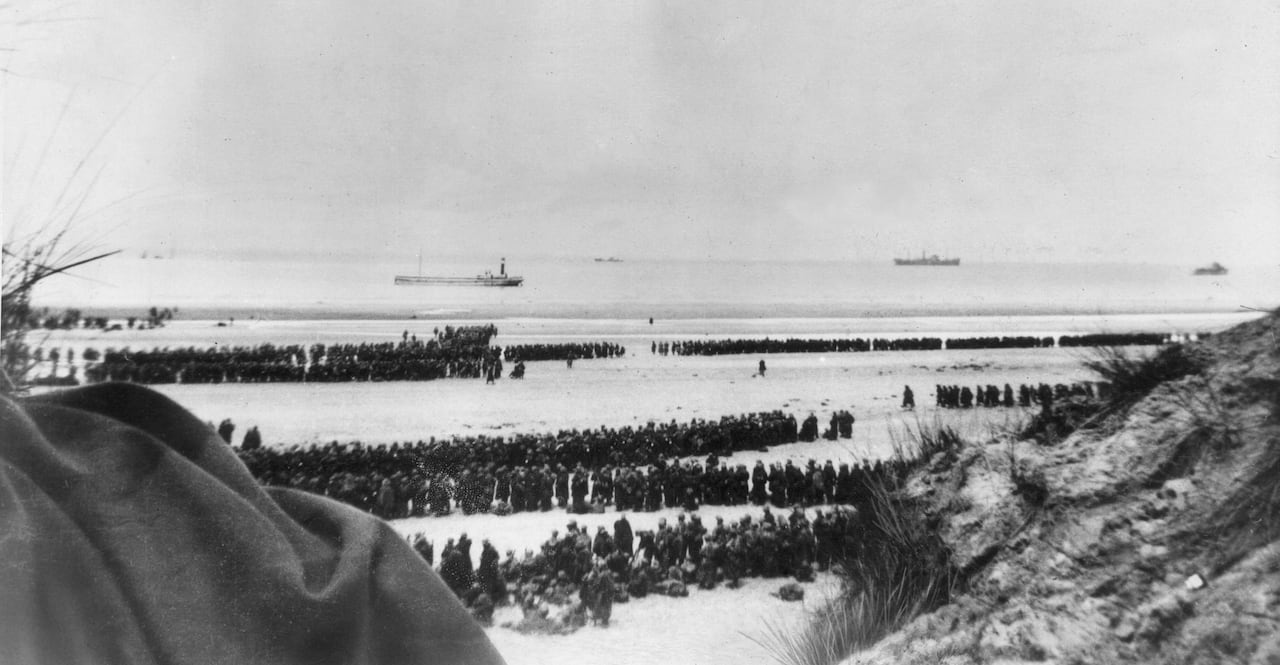
With France on the verge of surrender to the Germans in June, evacuations of British and other Allied forces occurred along the entire French coast – and not just at Dunkirk.
This undated photograph, taken in May or June 1940, shows British Expeditionary Forces and French troops waiting to be evacuated on the beach at Dunkirk, France. (Topical Press Agency/Getty Images)
On June 21, HMCS Fraser was in Saint-Jean-de-Luz, France, near the Spanish border, along with another Canadian destroyer, HMCS Restigouche, and other British ships.
“Over the next few days, Restigouche and Fraser will be part of the force on site off Saint-Jean-de-Luz as people are evacuated, and they are there to provide protection against possible attacks by German submarines or other German forces [ships’ boats] “Used to transport all of these evacuees from the port to ships waiting offshore,” Noakes said.
On June 25, the ships were forced to flee, Noakes said. The Fraser, Restigouche and a British ship, HMS Calcutta, headed north along the French coast.
He said some reports suggested the ships were traveling to help a French merchant ship avoid having to enter a port in occupied France where it would have been hijacked.
Shortly after sunset, the Fraser, Restigouche and Calcutta rearranged their journey together.
“It’s a complex situation,” Noakes said. “People literally do this for days without a break or rest because you want to get as many people out as possible.”
VIEW | Symbolic coin welded onto future HMCS Fraser:
The Halifax shipyard celebrates the keel laying of Canada’s first River-class destroyer
The ceremony at Irving Shipyard marked the official start of construction of the future HMCS Fraser. The CBC’s Ben Dornan was there for the centuries-old tradition.
As part of the maneuver, the Calcutta hit the front part of the Fraser, causing the front part of the Fraser to break off and sink into the Gironde Estuary.
Noakes said 47 people from the Fraser died, many of them Canadians, while some people were rescued from the part of the ship that briefly remained afloat or were rescued from the water.
He said part of the bridge of HMCS Fraser ended up on the bow of HMS Calcutta, allowing five people to literally climb onto the Calcutta from that part.
“The first loss of a Canadian warship in World War II was due to an accident rather than enemy action,” Noakes said.
Many of the surviving Fraser crew were transferred to a ship, the HMCS Margaree, which essentially acted as a replacement for the Fraser.
In October 1940, the Margaree was lost at sea in another collision.
Experience of a sailor
Frank Crossley’s father, Sid Crossley, served on HMCS Fraser, but not on HMCS Margaree. He suspects his father suffered from post-traumatic stress disorder, partly due to his time on the Fraser.
“That’s another aspect of his awareness of, you know, all of his comrades who were survivors of the Fraser and unfortunately perished on the Margaree,” Crossley said.
He said his father worked on sonar work during his 25-year military career and was likely on the Fraser Bridge when the collision with the Calcutta occurred.
He said his father was like Jekyll and Hyde and suffered from alcohol abuse.
“[It] “It might have helped if he and I could have talked about what he experienced,” Crossley said.
A second HMCS Fraser served Canada for about four decades until it arrived in Bridgewater, NS in 1997 and served as a floating museum. The ship was eventually recaptured by the military and eventually scrapped.
“A legacy to build on,” says the naval historian
At Friday’s ceremony in Halifax, a symbolic coin was welded onto the Fraser’s keel. The aim of the tradition is to bring good luck to the ship and its crew.
Freelance naval historian Roger Litwiller said it was common for navies to repeat ship names.
“It gives the sailors who serve on the ship a legacy to build on, it gives them something to be proud of and it just advances the history of not just the ship but the Royal Canadian Navy as a whole, from the past to the future,” he said.
MORE TOP STORIES