


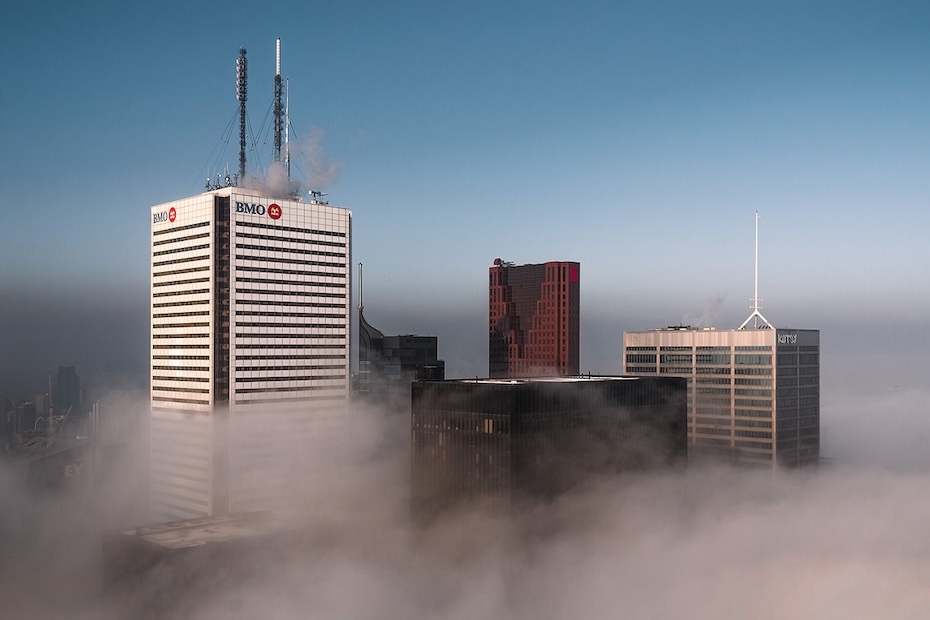
Toronto’s financial district isn’t just notable for its height. The headquarters of Canada’s largest banks collectively trace downtown’s architectural evolution over the past six decades, from the minimalist black steel-and-glass forms of the International Style era to contemporary office megaprojects. As new condominiums increasingly dominate Toronto’s skyline from across the harbor, the city’s most prominent commercial skyscrapers continue to serve as enduring symbols of Canadian corporate identity, with many designed by globally recognized architects.
TD Bank
No bank has made a greater impact on Toronto’s financial district than Toronto-Dominion Bank, now better known as TD, whose office portfolio includes several generations of buildings in the King and Bay area.
The Toronto-Dominion Center is the city’s first major modernist office complex and one of the defining works of architect Ludwig Mies van der Rohe. After the first two towers and the Bank Pavilion were completed in 1969, the black steel-and-glass buildings became the city’s first two International Style skyscrapers. TD gradually added three more towers to the Toronto-Dominion Center while also expanding its skyline presence with the addition of the then Canada Trust Tower at Brookfield Place in 1990, which rose 263 m and was recently renamed TD Place.
Most recently, TD placed its logo at the top of 160 Front West, a 750-foot-tall commercial tower designed by AS + GG Architecture in collaboration with B+H Architects for Cadillac Fairview. TD’s portion of the building is referred to as TD Terrace. The complex features historic facade along the eastern portion of its Front Street West facade.
160 Front West, image by UrbanToronto Forum contributor kotsy
First Canadian place
For decades, First Canadian Place was the undisputed king of the Toronto skyline. The 72-story skyscraper was completed in 1975 as the headquarters of the Bank of Montreal, now better known as BMO. It is 298 m high and remained Toronto’s tallest building for about half a century. The tower was designed in the International Style tradition established by the Toronto-Dominion Center and gained international prominence upon its completion as the tallest building in the world outside of New York City and Chicago. First Canadian Place helped solidify Toronto’s emergence as a major North American financial center during the rapid commercial expansion of the 1970s. Originally clad in white marble, the exterior was replaced with white glass between 2009 and 2012 after the marble began to crack due to Toronto’s mid-continental summer freeze-thaw-warm climate. Even after losing its title as the city’s tallest skyscraper, the tower remains one of the dominant elements of the skyline.
First Canadian Place, image by Kotsy, UrbanToronto Forum contributor
CIBC SQUARE
The Canadian Imperial Bank of Commerce’s Skyline presence was associated with the Commercial Court at King and Bay for decades. Now the skyline identity of the bank, best known as CIBC, has moved a few blocks south to CIBC SQUARE, a two-tower office complex that is reshaping the southern edge of the financial district east of Union Station. Designed by WilkinsonEyre Architects and Adamson Associates Architects for Ivanhoé Cambridge and Hines, the complex serves as a connected commercial campus connecting downtown’s traditional financial core with the South Core and waterfront districts. Standing at 237.73m and 241.39m tall respectively, the towers form a large new concentration of high-quality office space alongside a one-hectare elevated park spanning the railway corridor below. The first tower opened in 2021, while the second tower is nearing full occupancy and the final components have been completed.
CIBC SQUARE, image by UrbanToronto Forum contributor kotsy
Royal Bank Plaza
Although the presence of Royal Bank of Canada’s headquarters has historically been less determined by height than some of its competitors, Royal Bank Plaza remains one of the most recognizable business complexes in Canada. Completed in 1979 near Union Station, the two-tower building is best known for its distinctive gold-colored facades, composed of thousands of reflective windows coated with approximately 2,500 thinly spread ounces of 24-karat gold. The mostly triangular towers brought warm tones and a highly articulated structure to a financial district largely dominated by the more austere steel and glass modernism, arranged largely in rectangular shapes. Located on Front Street across from Union Station, Royal Bank Plaza maintains a strong architectural identity with its metallic appearance and mirrored composition, even as noticeably taller towers have sprung up around it. Since then, RBC has expanded its portfolio to include additional scattered towers in the Financial Core and South Core.
Royal Bank Plaza, image by Ed Skira
Scotia Plaza
The Bank of Nova Scotia’s Scotia Plaza has remained one of Toronto’s defining skyscrapers since its completion in 1988. At 275 m tall, the tower, with its reddish-brown granite and bronze-colored windows, represented a more postmodern interpretation of the Financial District skyscraper, contrasting with the black, silver and white towers of the previous modernist generation. Designed by WZMH Architects, the building is characterized by its long north-south proportions and stepped east-west sides, which give the massive office tower a comparatively slender appearance despite its large floor plates. The tower’s distinctive crown with Scotiabank logos at the north and south ends and V-shaped cuts on the east and west sides helped make it one of the city’s most visually distinctive skyscrapers.
Scotia Plaza, designed by WZMH Architects
* * *
UrbanToronto’s research and data service, UTPro, provides comprehensive data on construction projects in the Greater Golden Horseshoe – from proposal to completion. Other services include instant reports, downloadable snapshots based on location, and a daily subscription newsletter, New Development Insider, that tracks projects from the first application.
| Related companies: |
Adamson Associates Architects, Aercoustics Engineering Ltd, B+H Architects, BESI – Building Envelope Systems Installations, Doka Canada Ltd./Ltee, EllisDon, Grounded Engineering Inc., Hines, Isotherm Engineering Ltd., Kramer Design Associates Limited, LiveRoof Ontario Inc, LRI Engineering Inc., Peter McCann Architectural Models Inc., Precise ParkLink, Rebar Enterprises Inc, RJC Engineers, RWDI Climate and Performance Engineering, SPX Cooling Technologies Inc., ULMA Construction Systems Canada Inc., Urban Strategies Inc., Walters Group |