


Democrats warned Friday that a weaker-than-expected jobs report suggested the economy could slip into recession, suggesting the downturn was a result of President Trump’s decision to focus on ties abroad rather than problems at home.
The weak data appeared to put Republicans on the defensive, as many elected officials and candidates remained silent on the issue until Friday evening. Democrats had already begun putting the economy at the center of this year’s election, accusing Trump and his party of not doing more to curb consumer prices.
As gas costs have risen sharply since the start of the war with Iran, Democrats are leaning heavily toward arguing that Mr. Trump’s priorities are misplaced and are directly straining Americans’ wallets.
“This confirms what we have already felt, which is that this president has not been focused on the economy,” Sen. Andy Kim, Democrat of New Jersey, said in an interview, referring to the jobs numbers. He added: “The president has continually played with fire when it comes to the savings of American families.”
Mr. Trump has defended his economic policies, including a tariff system that the Supreme Court cut but which he has vowed to continue.
On Friday, the Labor Department reported that employers cut 92,000 jobs in February. According to the agency, the unemployment rate rose to 4.4 percent.
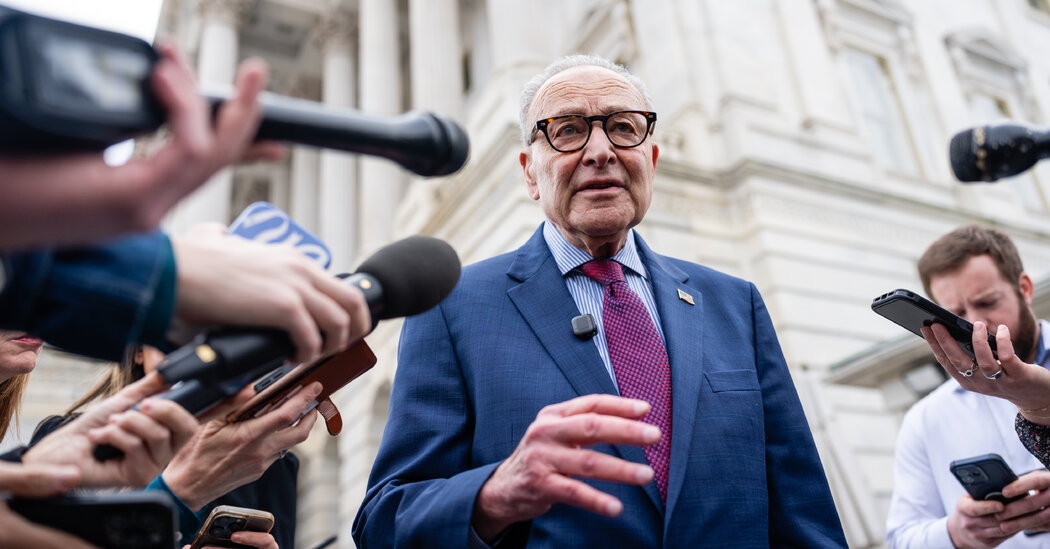
Senator Chuck Schumer of New York, the Democratic minority leader, said in a statement that the report was a “blaring alarm” that the economy was on the brink of a recession and could soon “fall over the cliff.”
“The Trump Republican agenda is failing the American people,” Mr. Schumer added, blaming Mr. Trump’s chaotic tariff policies for the weak jobs numbers.
Kevin A. Hassett, director of the National Economic Council, which oversees economic policy in the White House, acknowledged that the jobs numbers were a surprise. But he urged Americans to take a longer look at the economy and tried to link the numbers to the Trump administration’s crackdown on immigration policy.
“If you look at the average over a couple of months, we had a surprisingly positive one last month and a surprisingly negative one this month,” he told CNBC. “But on average it’s about what we expect because immigration has fallen so sharply.”
Before the report, JPMorgan Chase, the country’s largest bank, estimated the chance of a recession this year at 33 percent. The weak data could cloud that outlook, analysts warned on Friday. Ryan Sweet, chief U.S. economist at consultancy Oxford Economics, said the likelihood of a recession would increase, in part because the economy was buffeted by other forces, including a stock market rocked by rising oil prices.
Escalating violence in the Middle East has disrupted fuel supplies from the key oil and gas producing region.
“We just got hit after hit,” Mr. Sweet said. “The probability of a recession will subjectively increase.”
Rep. Mike Lawler of New York, who is seeking re-election and is considered one of the weakest Republicans in Congress, downplayed the jobs report, pointing to continued wage growth as a sign of economic resilience.
“We have already experienced similar month-long disruptions,” Lawler, who represents the Hudson Valley, said in a statement.
And a White House spokesman, Kush Desai, pointed to a nurses’ strike in California and Hawaii involving more than 30,000 workers, arguing that it weighed on the numbers. He noted that Americans still have not seen the full benefits of the president’s tariff policies.
“President Trump can walk and chew gum at the same time,” Desai said in a statement, adding: “Americans can be assured that the President will protect both our national and economic security.”
Still, many Republicans, facing a tough race, were hesitant to comment on the jobs report.
“What do you say?” said Doug Heye, a Republican strategist in Washington. “‘No, that doesn’t suck’? You’re kind of in a tough spot.”
He said Mr. Trump missed an opportunity in his State of the Union address last week to show how he was helping Americans with money problems. The slowing labor market is compounding problems for the government, which is struggling to keep prices low, he added, describing the data as “very difficult to manipulate.”
Mr. Trump, who ordered a military operation to capture Venezuelan leader Nicolás Maduro this winter and spent several weeks rattling Europe with threats to invade Greenland, did not address the jobs report during a nearly two-hour event on Friday focused on college sports. Like President Joseph R. Biden Jr. before him, he is trying to convince Americans that the economy is better than many believe.
“At this point, we all know that these economic indicators are always lagging behind what people are actually experiencing,” Graham Platner, an oyster farmer running for the Democratic Senate nomination in Maine, said in an interview. “Down here in the real world, everyone knows in their bones that this thing isn’t working for them and that the economy isn’t improving.”
He suggested that the week-long war in Iran would only increase economic turmoil. In Maine, gasoline prices rose about 30 cents a gallon last week, AAA reported, as Mr. Trump launched a military campaign in Iran that opinion polls show is unpopular with most voters.
Mr. Hassett told CNBC that the economy is “really strong” and is experiencing a “productivity boom.”
But the Democrats weren’t sold.
“Today’s jobs report underscores the complete failure of Trump and the Republicans’ agenda,” Sen. Kirsten Gillibrand of New York, chairwoman of the Democratic Senatorial Campaign Committee, said in a statement. “Their failed policies have led to job losses, higher prices and a weaker economy – while the American working class continues to pay the price.”