


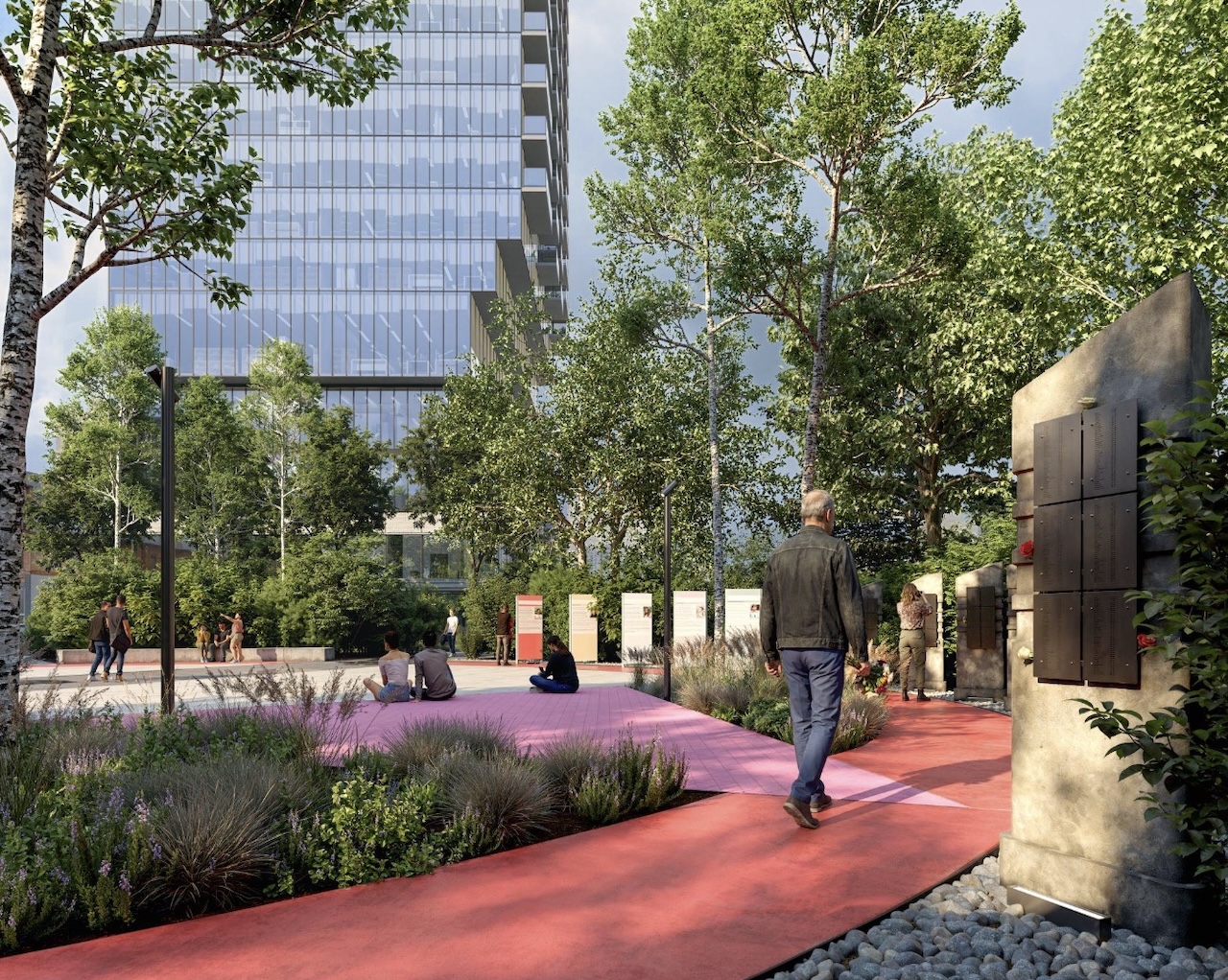
A community-driven proposal aims to reshape the future of Barbara Hall Park in Toronto’s Church-Wellesley Village, as concerns grow over the treatment of the AIDS memorial as part of the city’s ongoing redevelopment process. The Echoes initiative, developed independently by members of Toronto’s HIV-positive community, positions the memorial as a defining feature of the park, responding to criticism that recent plans have diminished its visibility and significance. The proposal, supported by a coalition of HIV/AIDS organizations across Ontario, combines spatial design and interpretive strategies aimed at restoring the site’s role as a place of remembrance while strengthening its relevance to people living with HIV today.
The City of Toronto has been moving forward with a redevelopment of Barbara Hall Park since 2023, with a public consultation process designed to guide changes to downtown green spaces. Throughout this process, residents living with HIV have expressed concerns that engagement has been inadequate, citing the limited inclusion of their perspectives in shaping the future of the AIDS memorial. Community members argue that the current orientation risks further marginalizing the monument within the park.
The Echoes proposal, image courtesy of Normandthegang and theaidsmemorial.ca
At the heart of the discussion is the condition of the AIDS memorial itself, which stores the names of nearly 3,000 people by year of death and is designed for future additions. Community members point to a decline in maintenance in recent years, citing the removal of plantings, including the monument’s rose bushes, as well as visible damage to engraved plaques from graffiti and surface wear.
Based on these concerns, the Echoes proposal was developed as a community-led alternative based on lived experience and research. Led by Toronto residents living with HIV, the initiative draws on months of historical studies, conversations with long-term survivors and input from local stakeholders to redefine the way the memorial is understood and experienced.
At the heart of the proposal is a comprehensive spatial and interpretive framework that reaffirms the memorial as the focal point of the park. The scheme introduces a number of interconnected elements including a ‘Sanctuary Grove’, an ‘Arc of Memory’, a ‘Poz Art Screen’, a ‘Circle of Care’ and ‘Reflection Commons’. Together, these components are intended to create moments of gathering, reflection and storytelling, using both physical design and interpretive features to foreground the human impact of the HIV/AIDS crisis and the activism surrounding it.
A top view of The Echoes proposal, image courtesy of Normandthegang and theaidsmemorial.ca
Building on the memorial’s existing structure, the proposal also calls for an expanded commemoration approach that extends beyond Toronto. While the site already allows names to be added over time, Echoes plans to expand this process to individuals across Canada, with a focus on communities that have been historically underrepresented. In this way, the monument would continue to develop as a living document.
The proposal received support from a broad cross-section of the HIV/AIDS sector and was supported by several AIDS service organizations across Ontario, including the Ontario AIDS Network, which represents more than 40 community-based groups. In total, over a dozen organizations have officially supported the initiative, thereby signaling the agreement between advocacy groups and service providers.
* * *
UrbanToronto’s research and data service, UTPro, provides comprehensive data on construction projects in the Greater Golden Horseshoe – from proposal to completion. Other services include instant reports, downloadable snapshots based on location, and a daily subscription newsletter, New Development Insider, that tracks projects from the first application.