


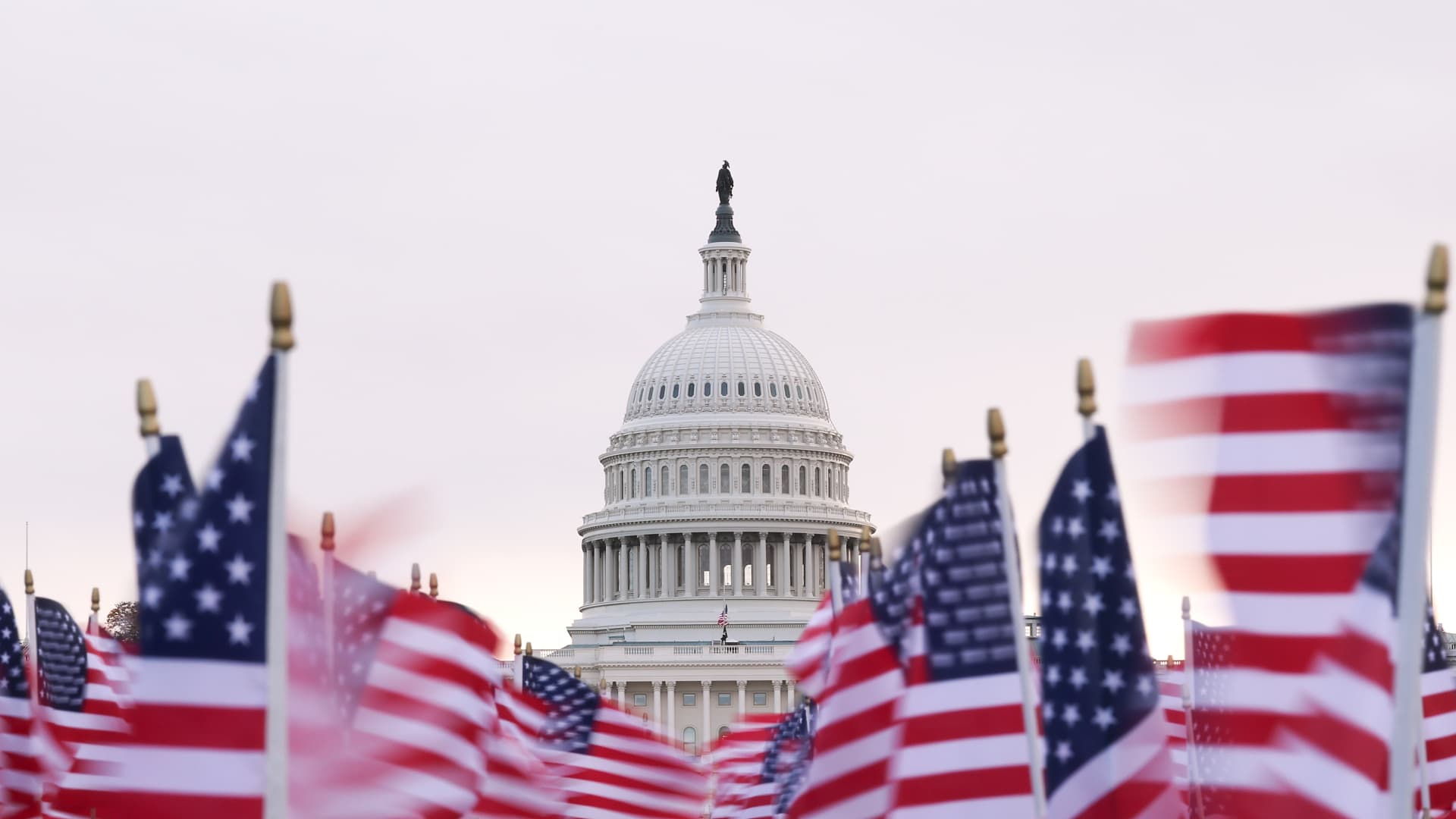
The US Capitol is shown on Capitol Hill in Washington, DC the morning after the Senate passed legislation to reopen the federal government on November 11, 2025.
Win McNamee | Getty Images
The Senate Agriculture Committee has released a draft of its portion of a highly anticipated digital asset market structure bill – a critical step toward accelerating institutional and retail adoption of cryptocurrencies.
The bipartisan discussion draft introduced Monday by Agriculture Chairman John Boozman (R-Ark.) and Sen. Cory Booker (DN.J.) lays the groundwork for creating guardrails for the crypto industry in the United States. It also sets guidelines for institutions that want to work with digital assets, from Bitcoin and Ether to tokenized financial instruments.
“This is the most consequential roadmap for how an institution will integrate digital assets into its business,” Cody Carbone, CEO of crypto trade association Digital Chamber, told CNBC. “It’s like the best possible step-by-step guide on what kind of compliance rules they need to follow to work with crypto.”
Here are five key takeaways from the discussion draft.
1. Grants favorable regulatory status to some cryptocurrencies
The text classifies some of the largest digital assets by market capitalization, such as Bitcoin and Ether, as “digital commodities” and places them under the purview of the Commodity Futures Trading Commission.
This provision removes a major barrier to adopting digital assets for institutional fiduciaries, Juan Leon, an analyst at crypto-focused asset manager Bitwise, told CNBC.
“Compliance and risk departments will finally have a federal law to point to,” Leon said. “That shifts the internal conversation… [and] It provides the legal certainty required to transfer assets into a formal, strategic allocation.”
It will also create “a highly bifurcated market” made up of regulated and unregulated tokens, with the former class of assets experiencing “massive inflows of institutional capital, high liquidity and a robust derivatives ecosystem.”
2. Requires crypto companies to segregate funds and manage conflicts of interest
The draft calls for crypto companies to “establish a separation of governance, human resources and financial resources between affiliated entities that perform different regulated functions.”
Bitwise’s Leon interprets the provision as a challenge to the “all-in-one” business model common among crypto exchanges. According to these models, an exchange, a broker, a custodian bank and a proprietary trading desk are combined in one unit.
In other words, Leon said digital asset companies could be required to keep their different businesses separate like traditional financial companies. The change would serve as a “keystone for institutional acceptance.”
3. Gives the CFTC more authority to regulate digital assets
The text gives the CFTC more authority and authorizes it to work with the Securities and Exchange Commission to issue joint regulations on crypto-related matters.
“The CFTC has been given much more power or authority to exercise jurisdiction over this industry,” Carbone said.
The change comes after the SEC served as the primary regulator for digital assets for years after ousting the CFTC to gain authority over the industry.
4. Allows the CFTC to charge fees
The draft would require regulated companies to pay fees to the CFTC. These fees would be used for registration of digital commodity exchanges, brokers and dealers, as well as oversight of regulated entities, as well as education and outreach.
5. Sets listing standards for tokens
The text requires that crypto exchanges only allow trading in digital assets that are “not readily susceptible to manipulation.”
It's a provision that could reduce the number of “rug pulls” and other scams still common in some parts of the crypto industry, with the aim of setting standards and building trust in the market.
What's next?
The Senate Agriculture Committee's discussion draft is far from final, but offers important insights into the direction of efforts to pass crypto-friendly regulations in the US, according to Carbone.
“It's not final, it's not finished yet, but this gives a good sense of where Congress is going and what the final rules might look like,” Carbone said.
The committee will likely spend the next few weeks seeking feedback on its draft, meaning it will be “almost impossible to get.” [a final version of this part of the bill] be completed by the end of the year,” he added.
However, this period will give lawmakers time to provide more specific guidance on several topics that are bracketed in the discussion draft or have not yet been finalized. These include provisions on anti-money laundering rules and regulations that apply specifically to decentralized financial actors.
Several crypto players plan to work with lawmakers to help clarify these details, among other things.
“We have long said that crypto is a bipartisan issue, and this bill from Chairman Boozman and Senator Booker reflects that,” Moonpay President Keith Grossman told CNBC. “It is vital that the legislation distinguishes between centralized intermediaries and decentralized systems and we look forward to working with the committee to get this right.”
According to Carbone, the discussion draft is just one part of a larger legislative effort to overhaul crypto industry regulations. Ultimately, the text will be combined with the Senate Banking Committee's draft digital asset market structure to create a comprehensive bill.
And while lawmakers are far from there in the process, crypto firms are finding other ways to work with regulators and other authorities to meaningfully advance their industry, Craig Salm, chief legal officer of Grayscale Investments, told CNBC.
“In the absence of comprehensive legislation, we have still seen significant progress on the regulatory front,” Salm said, adding that the SEC, the Internal Revenue Service and the Treasury Department recently issued guidance for use in crypto exchange-traded products. “Nevertheless, thoughtful legislation will be critical to solidifying the foundation of the digital assets industry in the U.S. and unlocking even greater value for investors and consumers.”