


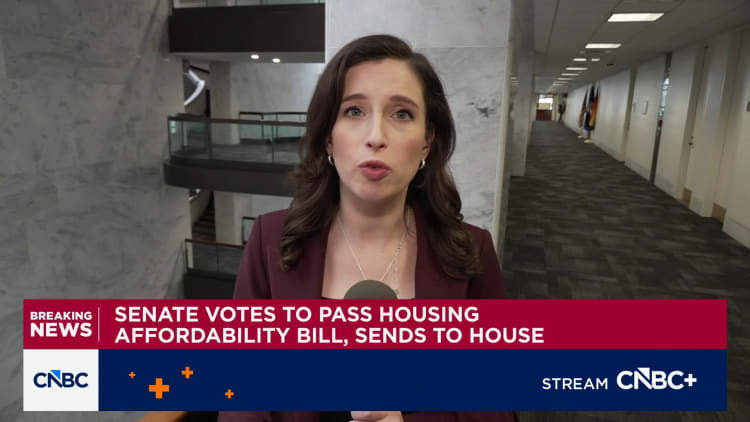
The Senate passed the largest housing affordability bill in 30 years on Thursday by a vote of 89-10, including a ban on investors buying single-family homes.
But the bill faces an uphill battle in the House, which passed its own bipartisan bill in February. House Republican leaders have already said the measure needs to be negotiated and have indicated they will not take up the Senate-passed bill. House Majority Leader Steve Scalise, R-La., told fellow House Republicans in a closed session earlier this week that the measure would likely stall because of differences between the two chambers’ versions.
One of the biggest problems is the ban on investors and companies from buying single-family homes if they already own 350 or more homes. Companies that expand the housing supply through new construction or extensive renovations could own more houses, but would have to sell these houses after seven years at the latest.
This provision was not originally included in either the Senate or House bills, but President Donald Trump supported the ban and indicated that he would not sign a bill without it.
Residential buildings and houses in the borough of Queens in New York, USA, on Friday, January 16, 2026.
Michael Nagle | Bloomberg | Getty Images
Numerous industry groups, including the National Association of Home Builders, the Mortgage Bankers Association and the National Housing Conference, said in a statement that the seven-year limit would eliminate rental housing production and “take hundreds of thousands of housing units off the market over the next decade, many of which would serve low- and moderate-income households.”
Sen. Elizabeth Warren, D-Mass., supported imposing the cap on institutional investment in home ownership, saying it would protect consumers.
“They can also build as many apartment buildings, as many condo complexes, as many three-family homes as they want,” Warren said in an interview with CNBC on Thursday. “But there’s a principled point here: Private equity can’t buy up all of America’s housing supply. Homes should be for families, not giant corporations.”
However, this view was not universally shared.
Sen. Brian Schatz, D-Hawaii, who voted against the bill, said the 350-unit cap was “bananas” and would ultimately lead to a ban on rental housing. Like Warren, Schatz has a liberal voting record.
“I don’t think people can predict how bad this is going to be on the supply side,” he said, adding that it will “disrupt” the single-family and semi-detached rental market.
Read more about CNBC’s politics coverage
Choose CNBC as your preferred source on Google and never miss a moment from the most trusted name in business news.