


Jamie Dimon, Chairman of JPMorgan Chase & Co., during the 2025 IIF Annual Membership Meeting in Washington, DC, USA, on Thursday, October 16, 2025.
Samuel Corum | Bloomberg | Getty Images
JPMorgan Chase CEO Jamie Dimon said Tuesday that while the Iran war poses short-term risks, it could ultimately improve the prospects for lasting peace in the Middle East.
“I think the Iran war offers a better chance in the long run – in the short term it’s probably riskier because we don’t know the outcome,” Dimon told Palantir executive and former congressman Mike Gallagher at a conference in Washington, DC
According to Dimon, the decisive change is the convergence of the interests of regional powers. Saudi Arabia, the United Arab Emirates, Qatar, the United States and Israel all wanted lasting peace, he said, adding that Gulf states in particular had shown a willingness to move in that direction.
“The attitude is not what it was 20 years ago,” Dimon said. “They all want it.”
The conflict began last month when the United States and Israel launched hundreds of attacks on Iran, including one that killed the country’s supreme leader. The war has reverberated across global markets as oil prices have skyrocketed due to supply disruptions. While stocks rose on Monday after President Donald Trump said in a social media post that the sides had discussed a “full and comprehensive solution” to the war, Iran denied that talks were taking place.
Dimon, who leads the world’s largest bank by market capitalization, also tied his contrarian view of the Middle East directly to the economy, arguing that the region’s need for foreign direct investment – which has flowed into the Gulf states for years – will dry up without stability.
“You can’t allow neighbors to drop ballistic missiles into their data centers,” he said.
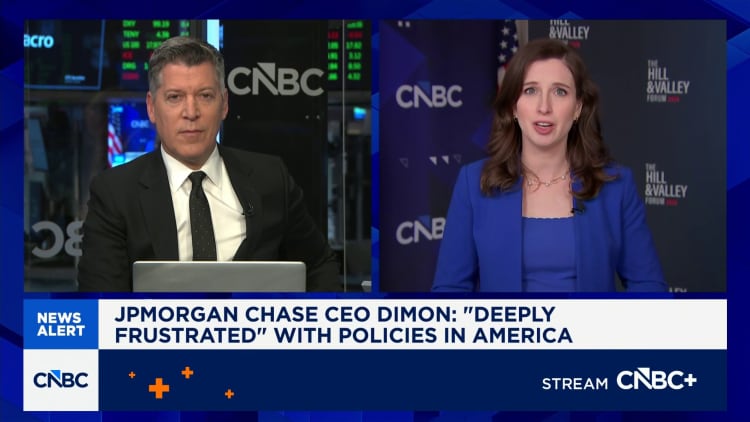
“Deeply frustrated”
In the extensive interview, Dimon touched on a range of topics, from the impact of artificial intelligence on the workforce to stablecoins to the bank’s new global headquarters in New York. But issues of national security and geopolitics took center stage.
The U.S. needs to “get its act together” when it comes to industries critical to national security, Dimon said, noting that was part of his motivation for creating a $1.5 trillion initiative last year.
“I am deeply frustrated … with our own policies in America, which have set us back,” Dimon said, citing the inability to produce enough ammunition as an example.
“We have become like Europe, we are unable to move and change, change budgeting, change procurement,” he said.
The U.S. government and corporate sector have “made a big mistake” in dealing with China in recent decades, including by becoming dependent on crucial components of the country, Dimon said.
He added that Americans should assume that a conflict could one day arise over China’s desire for Taiwan.
“We should acknowledge it [China has] “We’ve done some things great,” including building batteries, cars, drones and ships, Dimon said. “We should look at our own shortcomings and then be prepared to face them if they ever become an enemy.”
A victory in the wars in Ukraine and Iran “would be very helpful” in dealing with China, Dimon added.
Choose CNBC as your preferred source on Google and never miss a moment from the most trusted name in business news.