


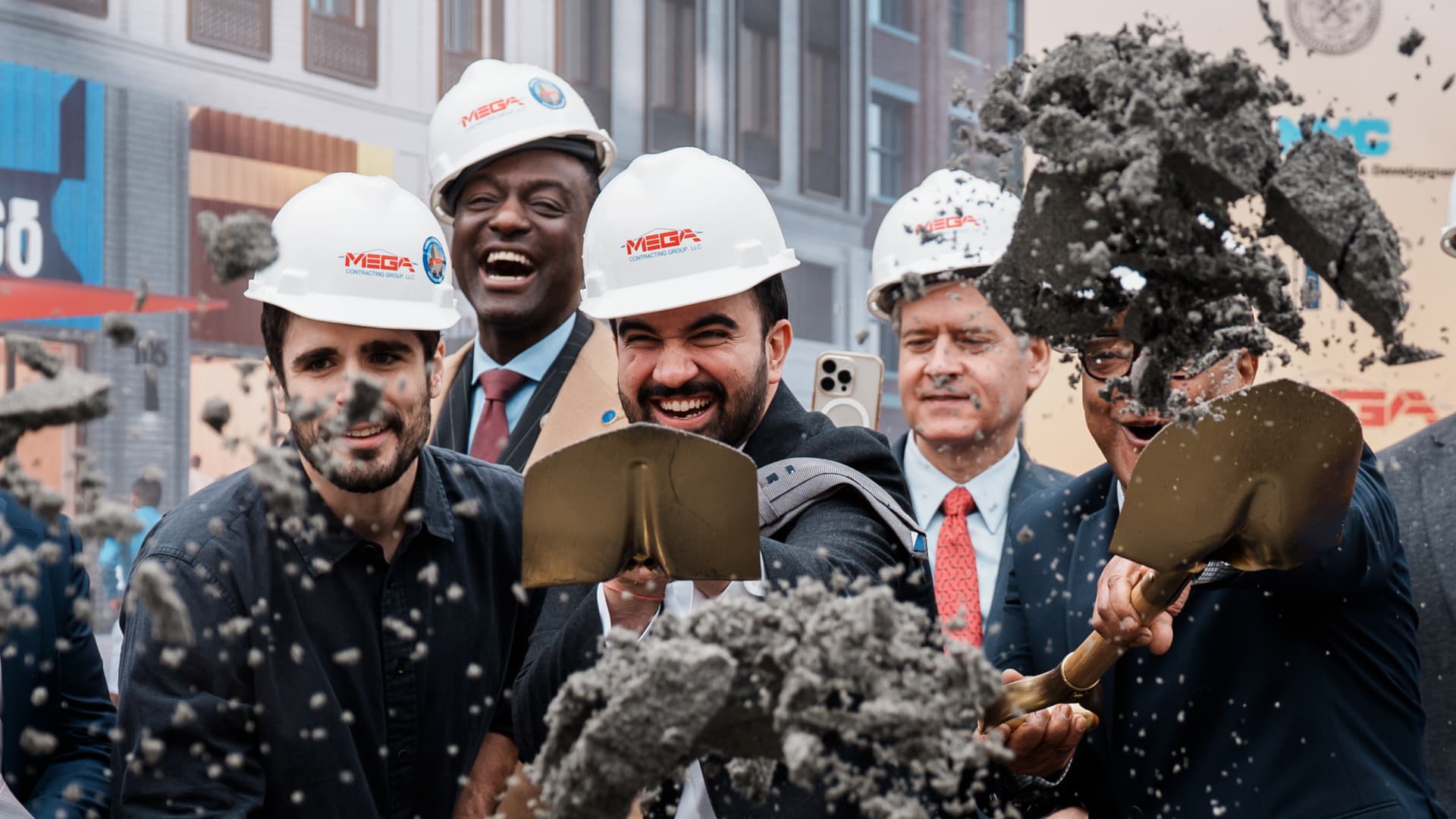
Fears of a corporate exodus from New York City are likely to be a recurring feature of New York Mayor Zohran Mamdani’s term in office, with every decision on commercial real estate portrayed as a potential tipping point and signaling that the Democratic Socialists’ tax, real estate and wealth policies are pushing out businesses.
The debate was heightened last week by reports about the private equity giant Apollo Global Management planned to build a second headquarters outside of New York City in a southern US state such as Florida or Texas.
Since her election, Mamdani’s government has said it will explore every possible option to increase revenue and close the city’s $5.4 billion budget deficit. However, his preference has not changed from what he advocated for: “tax the rich.” This has led to a political standoff with New York State Governor Kathy Hochul, who said ahead of her own re-election campaign that she would not agree to higher taxes on corporations and the wealthy.
“It’s a fragile environment today and we should be careful with this budget,” Steven Fulop, president and CEO of Partnership for New York City, said Monday on CNBC’s “Squawk Box.” His group represents corporate, investment and entrepreneurial firms. In an editorial he co-authored last week, Fulop warned that any plan to tax the wealthy and corporations will impact the cost equation for every New Yorker. “With New Yorkers already leaving the state in search of a lower cost of living, further price increases could send even more people packing and undermine the state’s long-term economic growth,” he argued in the Newsday article.
“Big companies [are] “We are certainly exploring other options: cheaper labor costs, lower taxes, less political uncertainty,” Vikram Malhotra, managing director of real estate equities at Mizuho, wrote by email.
This is nothing new. Lower-cost regions such as the US South are increasingly attracting both businesses and workers with cheaper real estate, lower tax burdens and fewer regulatory hurdles.
Wall Street is diversifying its office space
Financial firms are among the major companies expanding from both U.S. coasts to Texas and Florida.
JPMorgan just built a new office building in Manhattan but employs more people in its Dallas offices than in New York City. Cathie Wood’s ARK Investment Management moved from New York City to St. Petersburg, Florida. Wells Fargo moves its wealth management headquarters from San Francisco to West Palm Beach. Ken Griffin’s hedge fund giant Citadel moved its headquarters from Chicago to Miami, a move announced back in 2022. Griffin remains involved in at least one new major project in New York City.
While all of these moves reflect a longer-term trend that poses a risk to New York City, data from commercial real estate firm JLL covering the first quarter of Mamdani’s term shows that demand for office space and rents in Manhattan are rising while vacancy rates are falling. This continues a trend that prevailed at the end of last year before Mamdani’s term began, but overlapped with his election victory. According to JLL, companies continue to sign leases and compete for high-quality space in prime buildings, allowing landlords to drive up rents.
According to JLL, rental volume for high-end office space reached 8.5 million square feet in the first quarter, while vacancy fell 2.2 percentage points to 13.5%. Rents increased by 3.5% year-on-year.
While the commitment to long-term space is notable, the decisions are a mix of maintaining footholds and new growth. American Express announced in February that it would build a new headquarters in Lower Manhattan. Bank of America signed a 20-year commitment for its New York City office space in March.
“Despite economic uncertainty increasing almost daily, office leasing activity in NYC was strong in the first quarter of 2026, and significant exposure from American Express to 2 World Trade shows that New York is still the place where large tenants need/want to be,” JLL Vice Chairman Evan Margolin said in a statement.
An AI boom in Manhattan building leases
Another important factor in the strength of the Manhattan office market is the AI boom. According to JLL, leasing activities of AI companies in the first quarter about half of the total leasing volume in 2025. JLL described the AI rush as one characterized by companies racing to “conquer the space.”
Among the biggest AI deals in the first quarter: Nscale Global Holdings’ lease at One Vanderbilt, which JLL said was the highest rental price ever recorded in New York ($320 per square foot) and the first time an AI company has won this distinction. Booming legal AI firm Harvey signed a 92,000-square-foot expansion at One Madison Ave.
But the AI boom brings with it another source of uncertainty for the city’s real estate future. “The land grab for talent and space is immediate, but uncertainty is shaping how they engage,” JLL noted in its quarterly review. “AI companies in New York are taking up significantly more space than their current workforce requires in anticipation of expected new hires.”
JLL added that a notable feature of these leases is that AI companies “demand flexible lease structures with built-in customization mechanisms and reconfigurable facilities.”
The AI activity, Margolin warned, “is a trend reminiscent of the dot-com boom (and we can all remember how that ended).” But he added: “This time they are clearly focused on prime buildings in prime locations, driving the Class A market to new highs.”
Business leaders are cautious, weighing the costs to the city as new taxes are debated. Companies that rely on access to talent, capital and customers can continue to stay in New York. At the same time, the next office, team or expansion is more likely to end up in a more convenient location. “That’s why there’s going to be some sort of gradual exodus over time,” Fulop told CNBC.
Despite rising rents and net absorption of office space, as well as falling vacancies, JLL described overall market demand as “stable” and development activity as “measured”.
Any decision by a major corporation to leave New York has an impact on the city’s economy, with risks such as higher unemployment and lower tax revenue, Malhotra said. And specifically for the office real estate market, higher vacancies and lower rent increases are weighing on the business of commercial real estate companies, he added.
Fulop warned that policy decisions made now could determine whether New York can achieve future growth or continue to lose out at the margins. “I think this disparity is largely due to politics, and that’s the type of thing we need to address,” he said.