


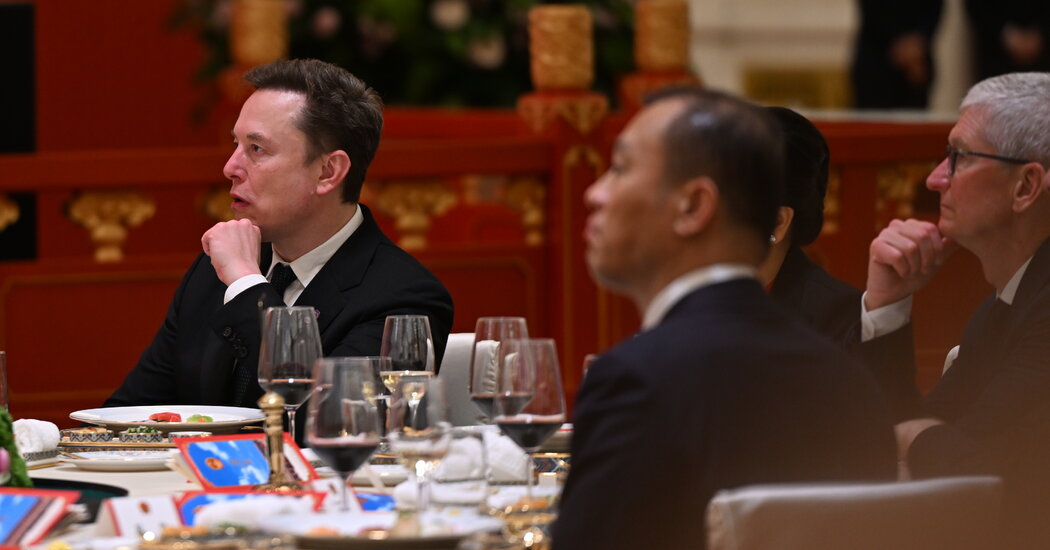
The business executives who accompanied President Trump to a meeting and large banquet in China last week sought to curry favor with both the Trump administration and the Chinese government, aware that support from both companies could make or break their businesses.
But the delegation – which included executives from Boeing, Apple, Nvidia, Cargill and other companies – arrived in Beijing with a host of commercial complaints about business in China, some of which are public and others not previously reported.
The Chinese government has in recent weeks blocked exports of high-end solar equipment from Chinese supplier Suzhou Maxwell Technologies to Elon Musk-led automaker Tesla, according to a person familiar with the matter who was not authorized to speak publicly. As part of its solar and energy storage business, Tesla wanted to buy nearly $3 billion worth of manufacturing assets from Suzhou Maxwell to build products that would further advance the transition to sustainable energy and bring about 100 gigawatts of solar capacity to the United States.
Tesla also has major business interests in China – its Shanghai factory is the largest – but Mr. Musk visited China hoping to boost the blockade of solar manufacturing exports, the person said. There is no sign yet that his efforts have been successful. Mr. Musk and Tesla did not respond to requests for comment.
A spokesman for the Chinese Embassy in Washington said they were not familiar with the situation but that China welcomes foreign companies doing business in China as long as they abide by laws and regulations.
Other companies in attendance had their own complaints. Coherent, a Pennsylvania semiconductor company that was part of the delegation, had difficulty obtaining indium phosphide, a material exported by China that is necessary for making photonic chips for data centers, other people said. China also has not yet approved the purchase of Nvidia’s H200 chips, although the U.S. government earlier this year approved the company to sell to major Chinese technology companies such as Alibaba, Tencent and ByteDance.
Last year, China lifted an export ban on Illumina, a biotech company present in the delegation, after Mr. Trump imposed tariffs on China last year. However, the company is still on China’s “Unreliable Companies List,” meaning some of its products cannot be purchased in China without government approval.
Chinese officials have ordered Meta, which was also present, to reverse its acquisition of artificial intelligence company Manus amid concerns about the drain of AI expertise from China. Last year, an antitrust investigation was launched against the chip company Qualcomm. And the Chinese government has classified products from present semiconductor maker Micron as a security risk, meaning Micron is barred from selling to certain Chinese companies operating in critical infrastructure.
Other problems have existed for a long time. Boeing had not had significant sales in China in about a decade due to geopolitical tensions and company security concerns.
Visa, unlike its main rival Mastercard, has never received a license to independently process credit card transactions in Chinese currency – even though the World Trade Organization ruled more than a decade ago that China discriminates against foreign credit card companies. Mr. Trump said in an interview last week that he had raised visa issues in his discussions with Chinese officials.
BlackRock, another company in the delegation, faced objections from the Chinese government to its bid to acquire dozens of ports from Hong Kong-based CK Hutchison. Like many manufacturers, GE Aerospace has struggled to source the rare earth elements needed for its engines, supplies of which China dominates. Cargill and other agricultural companies saw their sales to China decline when the country retaliated against Mr. Trump’s tariffs last year.
“They were there to solve specific bottlenecks,” Alison Szalwinski, vice president of Asia Group, a Washington consulting firm, said of the executives.
“Some of these companies were dealing with licensing issues, market access and supply chain approvals, all on a case-by-case basis,” she said. “Many of them expect to be able to move the ball forward on several of these issues.”
Multinational companies attempting to do business in both countries have often fallen victim to geopolitical tensions between the United States and China. The Chinese government has taken some of these measures to protect its companies from foreign competitors, while others have come in response to U.S. tariffs, sanctions or penalties against Chinese companies.
China is one of America’s largest trading partners but is also increasingly recognized as its main strategic rival. Ahead of the summit, U.S. officials debated whether more business with the country would help the United States or increase its vulnerability. But with Trump and Chinese President Xi Jinping scheduled to meet several times this year, some companies are hoping for more stable relations.
So far it is not clear that much has changed. After last week’s meeting, the U.S. and China announced the sale of American agricultural goods and aircraft to China – although the 200 Boeing planes China had committed to buying were fewer than some had expected before the summit. Chinese regulators also appeared in recent days to approve an application by Citi to set up its own investment firm in China. Nothing has been announced yet on other topics.
Industry officials say many of the companies involved in the trip have expressed interest in participating or have been contacted by David Perdue, the U.S. ambassador to China, as well as Scott Bessent, the treasury secretary, and Jamieson Greer, the trade representative.
But a week before the high-level visit between Mr. Trump and Mr. Xi, no chief executive had yet received an invitation.
On Monday, two days before the president’s departure, the White House announced a list of 17 participants. Conspicuously absent was Jensen Huang, the chief executive of Nvidia, whose chip sales to China have sparked controversy inside and outside the government. But Mr. Trump realized his oversight and called Mr. Huang at the last minute on Tuesday. Mr. Huang then met Air Force One refueling in Alaska.
While all of the companies attending the summit have important trades in China, people familiar with the trip warned that many had come simply to drum up goodwill with the Chinese and American governments or to appear as friends of the president – including Mr. Huang and Steve Schwarzman of the private equity firm Blackstone Group.
Most were on site in China for less than 48 hours, but the events were not without drama. The delegation’s senior staff had planned to attend a meeting with a Chinese official, Li Qiang, on Thursday afternoon and then proceed directly to the grand banquet at the Great Hall of the People in Tiananmen Square.
But on Thursday morning, just hours before Trump was scheduled to meet Xi in the heart of Beijing, aides to some of America’s most powerful leaders received a surprise late-night call from the White House.
The White House told them that plans had changed: Mr. Trump wanted the business leaders to also accompany him to his morning welcome meeting with Mr. Xi the next morning.
The next morning, Tim Cook, Mr. Musk and others stood on the steps of the Great Hall of the People just behind the state and finance ministers and other officials, shook Mr. Xi’s hand and then filed into the Great Hall. Sitting at a huge rectangular table, Mr. Trump said he had brought with him “the greatest businessmen, the greatest and I think the best in the world.”
“I didn’t want second or third in the company, I just wanted the top, and they’re here today to show respect to you and China,” Trump told Mr. Xi. “And they’re looking forward to trading and doing business.”
Because their presence was arranged at the last minute, the executives were delayed as they attempted to enter the hall. The White House wanted to invite them to the meeting in groups, and officials from Boeing, GE Aerospace and Cargill were brought in first. Then the remaining executives were unexpectedly called together, resulting in some of them having to be taken from a separate waiting room.
Since there weren’t enough chairs for everyone, the managers had to stand. Everyone took turns talking about their company and its problems. Mr. Xi responded with comments about the companies and their history, people with knowledge of the meeting said.
Back in Washington, White House Counsel Peter Navarro said in an interview on CNBC: “The Schwarzmans and the Finks and the Musks and the Apple people going there on that trip, I mean, that was embarrassing for those guys. I mean, they weren’t even allowed in the room at one point.”
“The Chinese just see these people as useful idiots,” he added. “They don’t have that kind of confidence, but that’s how they’re seen, and it’s difficult when we take our technology there.”
Executives disagreed. As some left the Great Hall of the People on Thursday, reporters shouted questions about how the meetings went. Mr. Cook flashed a peace sign and then gave a thumbs up.
Mr Musk said they had achieved “a lot of good things”.
“Mr Xi and President Trump have been incredible,” Mr Huang added.
Ryan Mac, Keith Bradsher and Tony Romm contributed reporting.