


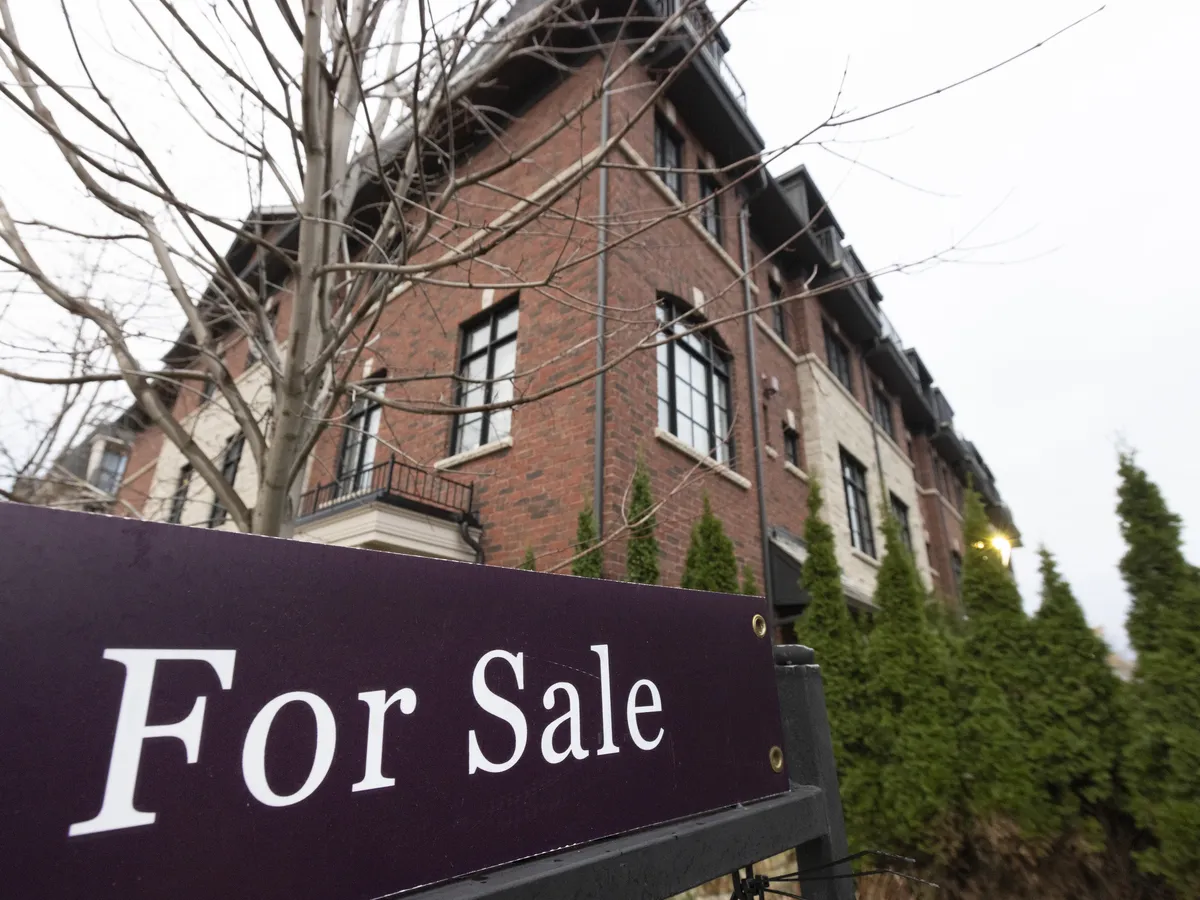
Josh thought he had cracked the code to home ownership after purchasing a three-bedroom home with a basement in Toronto five years ago.
Anxious not to move again, the tech executive, who asked not to be named to protect his privacy (he said Josh L. is doing well), blew his budget and took out a larger mortgage to buy a $1.3 million property with his wife.
The move initially seemed to work well. His real estate agent found him his first tenant, who stayed for two years before moving out in 2023. Josh was then inundated with “tons” of responses as he listed the property again.
“I could raise the rent significantly,” he said. “I think about 30 percent.”
But when his second tenant moved out in mid-2025, Josh began to see a different reality in the rental market. Very few people responded to his ad and most applications were not ideal, he said, as many did not have a permanent job and others wanted to live with four or five roommates.
He ended up having to lower the rent from $1,925 to $1,765 before he could finally get a couple to move in at the end of the year.
“I’m relieved, but it was a big change,” he said. “It was a huge burden on my wife and I’s lives. We were really worried.”
Josh said he believes the main reason for the change is the decline in immigration rates in Canada.
Canada’s population grew at a record pace by about one million people per year between 2021 and 2023. Immediately after the pandemic, the federal government at the time made it easier for foreign workers and international students to enter the country because there were hundreds of thousands of vacancies.
But the sharp increase in the number of people also contributed to the worsening of the housing crisis, which led to several offers for rental units, such as the one Josh offered in 2023.
That changed in 2024, when the federal government decided to limit the number of foreign students and workers entering the country, resulting in annual immigration targets being lowered.
These measures and some other government actions led to the first ever decline in the population growth rate in 2025 – a decline of 0.2 per cent, or about 102,000 people, according to Statistics Canada.
According to Giacomo Ladas, an associate director at Rentals.ca, asking rents — which landlords advertise — have fallen by about $200 a month since peaking in early 2024, but are still on average $300 to $400 higher than pre-pandemic levels.
Before the pandemic, rents were rising a few percentage points each year, but he said that trend has been “thrown out the window” as of February 2021. Between 2021 and 2024, annual asking rents in Canada increased by approximately $500 per month.
Many landlords now also offer incentives such as one or two months of free rent to attract tenants.
Ladas said sharp fluctuations in population growth in recent years have played a key role in impacting asking rents, but that is not the only factor as a new wave of condos and other homes have also come onto the market.
Some of these units were built by developers with the aim of being sold rather than rented, but failed to find a buyer due to lack of demand. He said many units are now being offered for rent because developers are trying to get some of their money back.
Ladas said the poor economy is another reason why young Canadians are choosing to stay home longer rather than enter the rental market.
The Greater Toronto Area (GTA) condo vacancy rate rose from 0.7 per cent to 0.9 per cent in October 2025, but that is still quite low, said Jordan Nanowski, senior economist for the GTA housing market at Canada Mortgage and Housing Corp. (CMHC).
He said the slower-than-expected increase was because many condo owners were individual investors who did not want to endure a few months of no rent, which is easier for a large, purpose-built landlord to tolerate and therefore more willing to make concessions and accept lower rents.
Buyers who entered at the peak of the market between 2021 and 2023 tend to feel the most pressure, said Gus Papaioannou of Realosophy Realty Inc.
“Someone who was buying at the time thought, ‘Well, the interest rates are one percent, yes, I’m buying too expensive, but this person is paying me an exorbitant amount to rent my basement. That’s fine,'” he said. “Nobody thought, ‘Oh my God, rents are going to go up so much and, by the way, the tenant now has to pay less because rents have gone down by 20 percent.'”
The situation has “worsened” over the past year amid a stagnating economy, Papaioannou said. Some of his clients didn’t want the burden of paying the $700 to $1,000 a month that their tenants were paying, so they decided to sell, although others with deeper pockets are willing to “hold out for a few years.”
It might still be worth persevering. Nanowski said the current market weakness is temporary and is “guaranteed” to reverse within a few years.
“There’s just so much rental supply coming online right now, but at some point there’s going to be a turnaround, like 2027, 2028 when that’s done, because new condos just aren’t being built,” he said.
Regardless of when the potential turnaround in the rental market occurs, homeowners like Josh are likely to remain cautious.
“At the time, everyone was like, ‘Oh my God, this is easy money, free money,'” he said. “Now they’re making noise and saying, ‘Is it really worth it?'”
• Email: nkarim@postmedia.com