


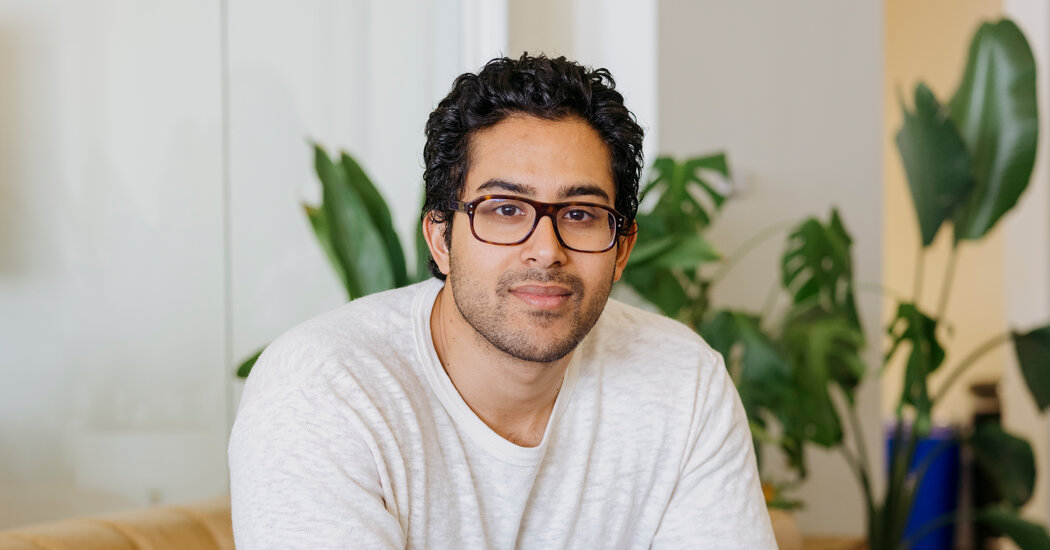
Akash Samant has long believed that he should cover most of the expenses in a relationship, be it rent, dates or holidays abroad. He grew up in Arizona and his parents raised him with the pride of caring for others. The boom in artificial intelligence in Silicon Valley helped him.
Mr Samant, 26, met his long-distance girlfriend Valeria Barojas, 24, on a dating app in September 2024 after co-founding Coverflow, an AI start-up that serves insurance agencies. The startup raised $4.8 million in venture capital funding last year. (Mr. Samant declined to disclose the company’s valuation.) He lives in San Francisco and Ms. Barojas is in Glendale, Ariz., where she is completing her bachelor’s degree in social work at Arizona State University and living on her savings.
When the couple visits each other, Mr. Samant pays for the flights. When they traveled to Paris together last year, he paid for the hotel and dinner. The couple hopes to move in together in the near future and plan to split housing costs in proportion to their income.
“I don’t expect to have to pay everything for them,” Mr. Samant said. “Ultimately I would like to do that, but I’m not doing that right now.”
Mr. Samant’s company has provided him with a compensation package that exceeds anything he previously earned in his engineering career. He earns a base salary of $120,000 to $160,000 and holds a significant equity stake as a co-founder. His dream scenario? He made enough money through the IPO or takeover of his company to give Ms. Barojas the opportunity to retire from professional life. But not without marriage, a topic that came up last month after he and Ms Barojas had been together for about a year and a half.
“Everyone’s efforts will always look different than someone else’s,” Ms. Barojas said of splitting expenses in a relationship. “My 100 percent can be someone’s 60 percent and vice versa.”
The AI frenzy is leading to personal fortunes rarely seen in modern technology and changing people’s attitudes about fairness and money in relationships. According to a survey of more than 1,000 people conducted last month by Blind, a forum where people can discuss work anonymously, nearly 25 percent of people said that increased compensation in the wake of the AI boom has changed the way they split expenses with a partner. About 9 percent of respondents said the AI boom has made them think differently about prenuptial agreements or financial protection.
Tech companies are paying AI employees premium salaries, with some researchers negotiating salary packages worth $250 million. Silicon Valley venture capitalists are raising billions of dollars to keep up with investments in AI startups. OpenAI, Anthropic and SpaceX, which recently merged with xAI, have taken steps toward IPOs. Those IPOs alone could create more than 16,000 millionaires, according to an estimate by Sacra, which conducts research on private markets.
For people who work in tech, a prenuptial agreement is often expected, said Lauren Lavender, chief marketing officer at HelloPrenup, a startup that enables couples to enter into prenuptial agreements. It can be more surprising if a couple doesn’t get one, she added. Some engineers who use HelloPrenup have equity compensation packages that are worth more than their base salary.
“People in the Bay Area are fully aware of the advantages they have because they work in an industry that could potentially be overtaken by AI,” she said. “They have a lifestyle that they want to protect.”
“I definitely rely on her for emotional support,” Mr. Samant said. But since he started his company before meeting Ms. Barojas, he said, he viewed financial success independently of their relationship.
Since Gujri Singh, 31, joined OpenAI as a member of the sales team in late 2023, signing a prenuptial agreement with a future partner before marriage is non-negotiable, she said.
“I know how hard it is for women to be financially independent and find themselves in situations where they have no control,” she said. “For me, that’s always been the scariest thing.”
Ms. Singh, who is single, said a former boyfriend became more understanding of her desire for a prenup after she was hired by OpenAI, where she said she earns between $200,000 and $300,000 a year in addition to shares in the private company.
“I think that what I have today will not be the totality of what I deserve in my career,” she said. “To be honest, I’m just getting started.”
OpenAI pays its employees more than any other major technology startup in history, the Wall Street Journal reported in December, with the company’s stock-based compensation alone expected to reach an average of $1.5 million per employee in 2025. (The New York Times has sued OpenAI and its partner Microsoft for copyright infringement of news content. Both companies have denied wrongdoing.)
Highly paid employees make relationship and money decisions amid uncertainty about whether their equity will plunge or rise, whether their company will go public or be acquired, and whether the AI bubble will burst. “This uncertainty is one of the main reasons tech workers are drawn to prenuptial agreements,” said Sam Mockford, associate wealth adviser at San Francisco-based Citrine Capital.
“A prenuptial agreement means thinking about the near future and the distant future and the what-if future,” she said. “And when you look at equity, there is a lot of fluctuation in terms of your future wealth.”
Even among couples where both partners work in high-paying fields like consulting and technology, the AI gold rush has widened the pay gap.
Megan Lieu, 29, founder of ML Data, a company that creates content about AI and technology, said her revenue has skyrocketed since 2022, the year ChatGPT was released. It has since partnered with Anthropic, Nvidia, Salesforce and Adobe, all companies that have benefited financially from artificial intelligence.
Ms. Lieu’s company generated more than $660,000 last year, with brand deals the main source of revenue, she said. She earns about five times as much as her boyfriend Daniel Kim, 32, who works in management consulting, and they live together in the Washington, D.C. area at a property she owns. Although Mr. Kim pays Ms. Lieu about the same share of the mortgage costs each month, she covers a larger share of other housing costs — such as homeowners’ association fees and utilities.
“Being in the world of content creation around AI, I have met many other women, families and people who have such unconventional households – where sometimes the woman makes the greater contribution,” said Ms. Lieu. She said that she viewed Mr. Kim as her equal and that the income difference had not caused tension in their relationship.
“I would never consider my partner a competitor, but I would say that I’m usually pretty competitive compared to my peers,” she said.
Mr. Kim said he would prefer to cover everyday expenses, including picking up the check on dates and paying the couple’s grocery bills.
“It’s just a kind gesture that I want to do to my girlfriend, and I enjoy doing that kind of gesture,” he said. “The same goes for my family and my dogs. I just enjoy giving them a kind gesture when I can.”
Ms. Lieu and Mr. Kim have spoken informally about what a prenuptial agreement might look like. When a person’s investment explodes, they don’t necessarily look at it as an individual, but say that the other partner contributed indirectly, whether through support or sacrifice.
“If you agree to a marriage,” he said, “you are, in a sense, agreeing to a marriage.”