


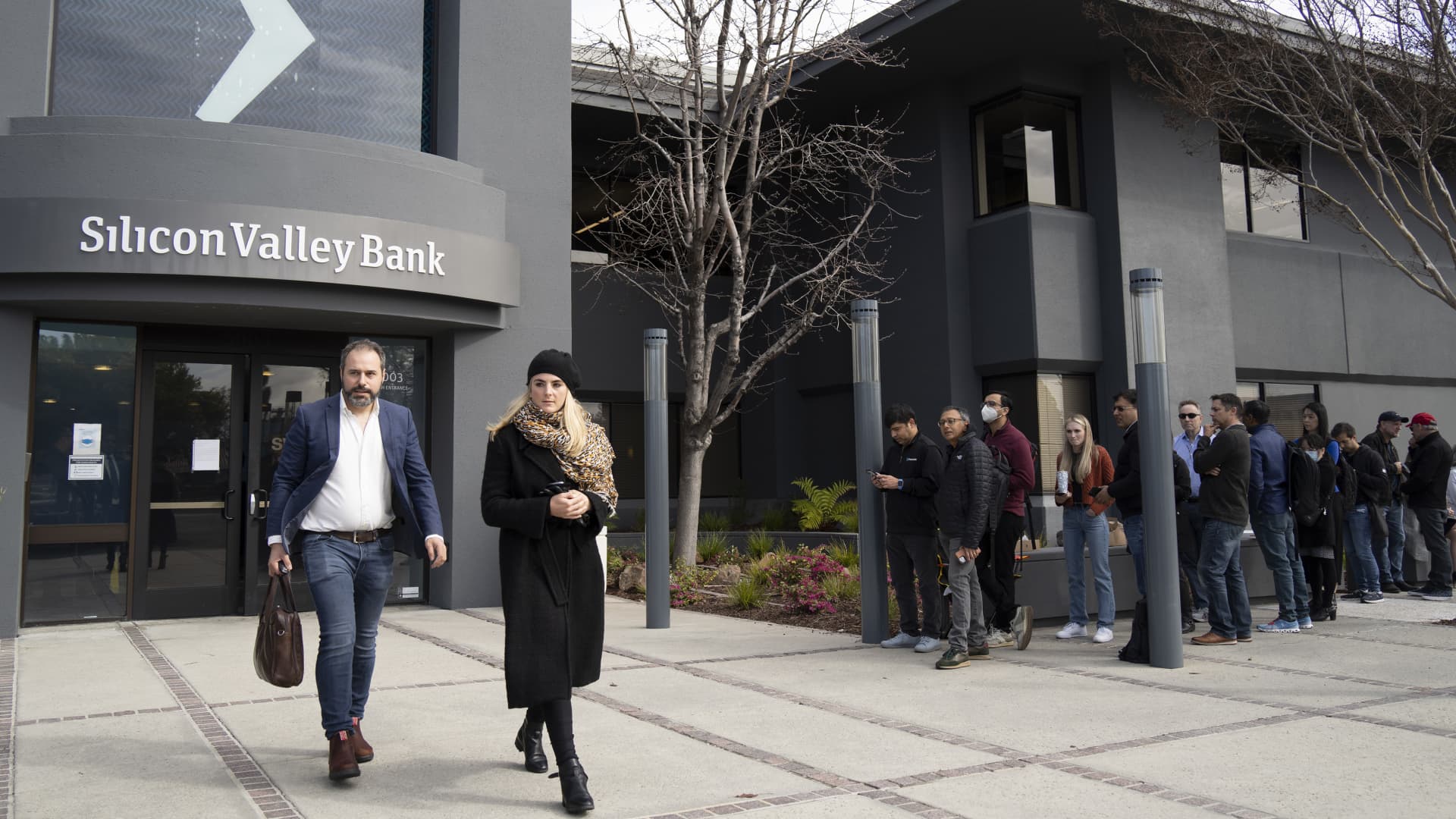
People line up outside the closed headquarters of Silicon Valley Bank (SVB) in Santa Clara, California, on March 10, 2023.
Justin Sullivan | Getty Images
Three years ago, JPMorgan Chase CEO Doug Petno was at a party in New York City to celebrate the retirement of a colleague when his boss, Jamie Dimon, called Petno over.
It was March 9, 2023, and customers of a West Coast lender known for serving startups had been withdrawing deposits in droves.
“Jamie looks at me and says, ‘Get on this call,'” Petno told CNBC in an exclusive interview this week.
Regulators were on the phone with an urgent question: Was JPMorgan interested in buying Silicon Valley Bank?
California financial regulators seized SVB the next day, completing the sudden collapse of an institution at the heart of America’s startup community. This weekend, Dimon, Petno and other JPMorgan executives repeatedly considered whether to buy the bank, which had just lost $42 billion in deposits. They decided against it, partly because thousands of SVB customers were already registering JPMorgan accounts as they fled to safety.
“We had three years’ worth of new customers in one weekend,” said Petno, co-head of JPMorgan’s commercial and investment bank. “Onboarding teams opened accounts 24/7.”
Encouraged by what they saw, Petno had an idea: What if JPMorgan could build a real competitor to SVB – just like startups Brex, Ramp and Mercury – which had all created a profitable niche for founders and venture capital investors?
“We went to our board and said there is a vacuum in the market,” Petno told CNBC. “At that moment everyone saw the opportunity.”
Keep track
For JPMorgan, already a giant in Main Street and Wall Street finance, capturing the more specific niche of startup banking from West Coast rivals is about more than just attracting deposits. It’s both a key part of the growth strategy of a bank that had revenue of more than $180 billion last year and a way to help the New York-based lender stay abreast of technological developments itself.
JPMorgan, which has a technology budget of nearly $20 billion this year, is committed to not only better serving startup clients and VC investors but also learning from them. The company is closely watching Silicon Valley startups to find solutions to problems facing the bank itself, from cybersecurity to quantum computing.
In fact, when a JPMorgan client announces a series of AI-related job and spending cuts, the company often sends a team of bankers to investigate how the client is doing it, Petno said.
Typically, bankers find that implementing new AI agents accounts for only a fraction of the reasons for layoffs, while other factors such as overstaffing and inefficient processes make up the rest, he said.
Co-CEOs of the Commercial & Investment Bank at JPMorganChase, Troy Rohrbaugh and Douglas Petno.
Courtesy of JPMorganChase
JPMorgan began its startup banking business in 2016 when it became aware of its tech-focused competitors during its westward expansion. Initially, it only served larger, more mature startups.
This is partly because the bank does not yet have a digital banking solution, which younger founders in particular are longing for, said Petno. Plus, there weren’t enough investment bankers back then to target smaller, riskier startups.
For years, some members of the VC community told JPMorgan that it took too long to open an account or that resolving payment issues involved time-consuming trips to a branch, investors told CNBC.
“They want to go to the website to open an account, and if it takes more than 15 minutes, they’re done,” Petno says.
But in the weeks following the SVB collapse, Petno and his team acted quickly and hired several key players from SVB, including then-SVB Capital president John China, who now runs JPMorgan’s innovation economics business with Andrew Kresse.
At the end of April 2023, JPMorgan was considering buying another troubled California bank. This time First Republic won the bid and also targeted the tech community.
With new insights from SVB and First Republic’s banking business, JPMorgan was able to double its startup banking revenue in 2023, according to the company.
Despite the focus on digital banking, sometimes a startup founder still walks into a Chase branch to deposit a huge funding check into a regular account. When that happens, JPMorgan’s systems immediately transfer that customer to the startup team, Petno says.
Killer app?
According to the lender, JPMorgan has now quadrupled the firm’s total customers to nearly 12,000 and is served by 550 bankers on both coasts, all drawing resources from different parts of the firm.
Founders and VC investors are clients of the private bank, while the startups are covered by the commercial bank and VC funds are separate clients of a company largely acquired by First Republic.
While JPMorgan declined to provide specific revenue figures, Petno said the startup company had a “dramatically higher” growth rate than the bank’s core businesses.
Still, Petno is still not satisfied with the company’s digital banking offerings for startups, describing an ongoing project that will help them overtake the competition.
Competitors in this area include SVB, which is now owned by First Citizens Bank, and the startups Mercury and Ramp Stifel And customer bank. In January, Capital One acquired Brex for $5.15 billion.
Because most startups fail, JPMorgan identifies companies it expects to win and tries to build relationships with them earlier in their life cycle, like SVB did.
This allows them to not only provide core banking accounts, but also offer lucrative investment banking advice on the side.
JPMorgan’s ultimate vision is to become the one-stop shop for founders, meeting all their needs, including international expansion, from seed round to IPO and beyond.
“Once you’re on board, you can never outgrow JPMorgan, from the unicorn to the Magnificent 7,” Petno said.
Choose CNBC as your preferred source on Google and never miss a moment from the most trusted name in business news.