


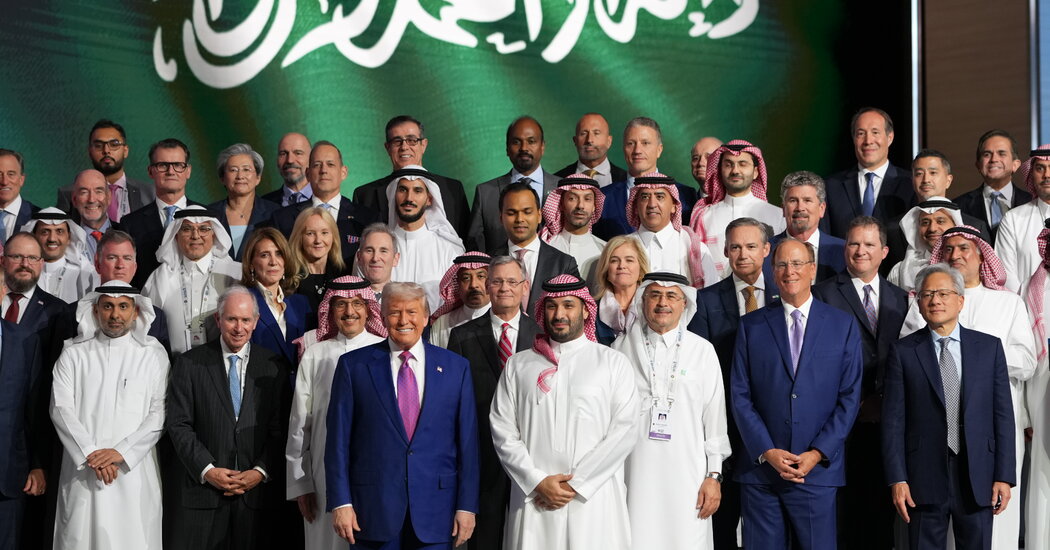
President Trump’s determination to disrupt the current world order has spawned a cottage industry dedicated to explaining his view of how the world works and America’s role in it.
Professors and pundits have invoked great power politics and ruthless realism, as well as former presidents and authoritarian strongmen. But there’s a new theory that’s getting attention. It is argued that Mr Trump’s reign most closely resembles that of 16th-century royal families such as the Tudors and the Habsburgs.
A key feature of this “neoroyalist” approach is that global economic policy is based on personal, family and business ties rather than on national interests, competitive advantages, shared prosperity or long-term growth.
Forget James Monroe, Metternich or Machiavelli. Think of Henry VIII and Emperor Charles V.
The term neo-royalism to describe Mr. Trump was coined by two political scientists, Abraham L. Newman at Georgetown and Stacie Goddard at Wellesley College.
In the United States, “foreign policy has become a tool for funneling money and status to Mr. Trump and his closest aides,” the two explained in a recent opinion essay in the New York Times. “Rather than compete with rivals, Mr. Trump is willing to work with them to advance his court’s parochial interests.”
The reference to royalism resonated because it reflected the president’s imperious governing style, his policy shifts and his disregard for long-standing international rules – not to mention his admiration for the British monarchy.
The theory has much in common with the kind of crony capitalism practiced by authoritarian forces like Ferdinand Marcos in the Philippines and Vladimir V. Putin in Russia.
Both describe a system built around a clique of economic and political elites who use economic policy for personal gain.
Filipe Campante, a professor at Johns Hopkins University, argues that Trump’s approach is bad for the economy.
Policymaking is “no longer about being more competitive in the market, but about connections,” Campante said.
The winners are “not necessarily the people who have the best ideas or the best projects,” he said, a situation that harms “growth, productivity and prosperity.”
Those who do not belong to the president’s circle or oppose him are threatened with punishment and exclusion from government contracts, regulatory approvals and other rewards.
After Elon Musk began criticizing the president last spring, Trump threatened to cut government ties with Musk’s vast business empire.
“The easiest way to save billions and billions of dollars in our budget is to end Elon’s government subsidies and contracts,” Trump wrote on Truth Social.
Political decisions that are primarily focused on personal profit or pique undermine growth. The 2024 Nobel Prize in Economic Sciences was awarded for research showing how the concentration of power, resources and opportunities in the hands of a small political elite limits development and prosperity.
A current case is the unusual deal to establish a US version of TikTok, the social media app from the Chinese company ByteDance. A law invoked on national security grounds and supported by Republicans and Democrats required TikTok to give up its Chinese ownership or close down.
But the new rule, approved by the government, allows the platform, on which Mr. Trump has more than 16 million followers, to continue operating in the United States.
The largest investors in the new TikTok company include allies and business partners of the president’s family or his inner circle:
Software giant Oracle, co-founded by Larry Ellison, a close Trump supporter; MGX, an Emirati investment firm that struck a deal with the Trump family’s cryptocurrency company; and Silver Lake, which partnered with the private equity firm founded by President Jared Kushner’s son-in-law.
Deals that allow Nvidia to sell chips to China, the United Arab Emirates and Saudi Arabia and extend military guarantees to Qatar also fit the neo-royalist pattern.
This personalistic economic policy goes beyond business. Mr. Trump acknowledged that he raised the Swiss tariff from 30 percent to 39 percent because former President Karin Keller-Sutter “just rubbed me the wrong way.”
He said he imposed 50 percent tariffs on Brazil because the government refused to stop prosecuting his political ally, former Brazilian President Jair Bolsonaro, who was convicted of plotting an attempted coup.
Self-serving policymaking creates uncertainty and hinders investment as rules governing decisions and contracts become confused.
And it makes it harder to get things done.
Traditional channels of communication with foreign powers have often been ineffective because so much decision-making power rests with the president’s clique.
Instead of bureaucracies, there is a royal entourage, said Mr. Newman of Georgetown.
As Mr. Trump considered whether to formally enter the 2015 presidential campaign, he founded a men’s cologne brand called Empire. Because, he explained, “every man must build his own empire.”
The financial empire of Mr. Trump and his closest allies is thriving. It is estimated that his family empire has earned at least $1.4 billion so far.