


The Trump administration has taken a novel approach as it looks for ways to impose new tariffs to replace those invalidated by the Supreme Court. A new trade investigation was launched in March targeting 59 countries and the European Union, imposing potential tariffs unless they adopt laws banning the import of goods made using forced labor.
In two days of hearings on the investigation in Washington this week, human rights advocates and business leaders broadly praised the move and said it would likely lead to a significant expansion of global legislation to combat forced labor. But they also expressed a number of cautionary messages, saying the government must ensure that other countries actually enforce any new laws and that the efforts do not backfire.
Some of the witnesses argued that the Trump administration’s proposed additional tariffs could strain the resources foreign governments need to police labor violations or harm vulnerable foreign workers rather than help them by disrupting trade with the United States.
Others argued that forced labor occurs in fields, in factories, and on fishing vessels, and that import bans risk missing where labor violations actually occur.
Trade experts welcomed the government’s focus on forced labor but also questioned its motivation. The investigation targets all of the country’s major trading partners – including Canada and the European Union, which have the most progressive forced labor laws outside the United States. And it excludes some smaller countries where the U.S. government has identified slavery, human trafficking or forced labor, such as Afghanistan, Belarus, Myanmar and Mauritania.
Some are wondering whether the administration’s action is more of a pretext for imposing tariffs that U.S. officials want to put in place anyway, and whether foreign countries will be able to take action to roll back the tariffs.
An official at the Office of the U.S. Trade Representative, which is overseeing the trade investigation, said the focus is “to assess how import bans on forced labor are imposed and enforced in the context of key trading partners who are the largest consumers and can limit demand for goods made with forced labor.”
“This investigation,” the official added, “also underscores how trading partners’ failure to eradicate these abhorrent practices is negatively impacting U.S. workers and businesses.”
Annick Febrey, co-founder of Better Trade Collective, a consulting firm that focuses on ethical supply chains, said at the hearing that import bans would help, but that what was most important was if other countries actually had a “workable system” to combat forced labor. Even if some countries pass laws to ban certain imports, they may lack the infrastructure to detain suspicious goods, the government coordination to respond to what they find or the political will to consistently punish the guilty companies, she said.
The legislation is important, “but it cannot be the only measure,” she said.
The hearings come as the Trump administration prepares to impose new tariffs to replace those imposed by the Supreme Court in February. Following the Supreme Court decision, President Trump imposed a 10 percent global tariff on all imports. However, that measure is set to expire in July without reauthorization from Congress.
To replace this, the Trump administration launched two trade investigations under a statutory provision called Section 301. One relates to import bans on forced labor and the other to what the government calls excess productive capacity. Hearings on the trade inquiry into overcapacity are scheduled to take place in Washington next week.
Given support from Democrats and civil society groups for measures to improve working conditions, the Trump administration’s tariffs on forced labor laws could prove more politically durable than other approaches.
Samir Goswami, who directs the forced labor program at Global Rights Compliance, an international law foundation, acknowledged that the Trump administration may have other political reasons for targeting forced labor, but argued that the measure was still beneficial.
“If we are able to stop the importation of forced labor goods at the border, we can push our trading partners to impose bans so that goods made with forced labor do not enter global markets. I think that is a positive thing,” he said.
Kush Desai, a White House spokesman, said forced foreign labor is not just a humanitarian problem but “a grave threat to American workers and industries.”
“The Trump administration’s historic Section 301 investigation will ensure that perpetrators of forced labor practices cannot unduly benefit from unfettered access to the American economy and that American workers are no longer unfairly undermined,” he said.
In hearings this week, groups representing shoe and technology companies said tariffs should be narrowly limited. Otherwise, they said, the tariffs risk increasing costs for consumers and leading to retaliation from trading partners.
Mihir Torsekar, an economist with the Coalition for Prosperous America, argued that forced labor acts as a “hidden production subsidy” that makes foreign products cheaper than U.S.-made ones and undercuts legitimate U.S. companies.
Others called on the United States to better enforce its own rules against imports of goods made with forced labor, including a 2021 law banning most products from Xinjiang, a region in China’s far west. The 2021 law created a blacklist of companies whose supply chains are proven to involve forced labor. However, no new companies have been added to this list since the Biden administration.
Some forced labor experts said the Trump administration has been hesitant to address the issue for fear of disrupting relations with China. Washington and Beijing got into a turbulent trade dispute last year after Mr. Trump imposed tough tariffs on Chinese exports, and China responded by restricting exports of minerals needed by various American manufacturers.
“I worry that the U.S. government may be lax in enforcing forced labor because it is wary of China,” said Laura Murphy, a former Biden administration official who helped enforce the U.S. ban. She said it was “no secret” that enforcement of the forced labor ban had weakened under Trump.
The United States has more progressive forced labor laws than any other country. The United States has a nearly century-old ban on imports made with forced, convict or contract labor, as well as the 2021 law restricting imports from Xinjiang.
Most other countries do not monitor their imports for such labor violations. Canada and Mexico have imposed import bans on forced labor as part of the U.S.-Mexico-Canada trade agreement, while the European Union has imposed a ban on products proven to be made with forced labor that will be fully enforceable next year.
Even if a country passes laws, ensuring that they are enforced is a much more difficult task. In the United States, the Department of Homeland Security, which oversees Customs Enforcement, has focused on enforcing the Trump administration’s changes to immigration policy.
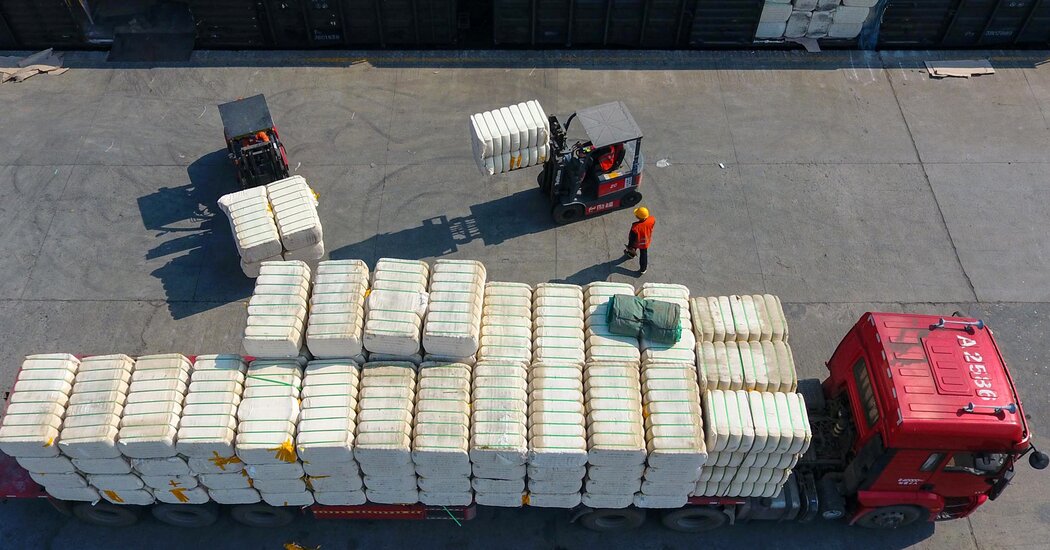
Some experts say imports of banned goods remain widespread. A New York Times investigation last month found that some Labubus — a viral doll made by a Chinese company — contained cotton from Xinjiang.
Brett Tipple, chief scientist and president of a testing company called FloraTrace that tests coffee and other foods for their origins, said his recent test of various brands of peppers on U.S. store shelves found that all of the products came from China and 60 percent of them from Xinjiang. This happened even though many brands were labeled “made in USA,” he said.
“This is a pretty well-known problem in the industry,” he said, adding that the government “hasn’t really done enough with what they already have.”
A spokeswoman for U.S. Customs and Border Protection said the United States is a global leader in combating forced labor and that it continues to prioritize enforcement of forced labor laws. In fiscal year 2025, the bureau stopped about 954 shipments per month, compared to an average of 944 the previous year, while the total number of stopped shipments also increased, she said.