


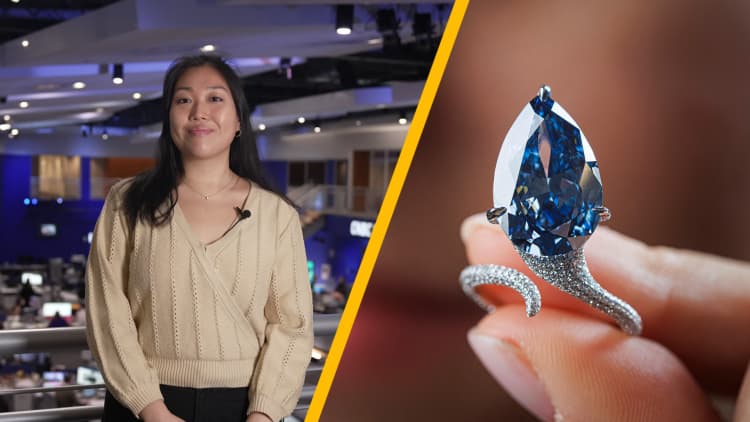
When the hammer fell in December, Christie’s had set a record that caused a stir in the auction world.
A Tiffany & Co. necklace adorned with a sparkling blue Paraiba tourmaline gemstone and diamonds sold for more than $4.2 million, 10 times its low estimate. Next to hit the market was a matching pair of earrings, which also sold for ten times its estimated price.
A 13.54-carat Paraiba tourmaline and diamond necklace from Tiffany & Co. sold for $4.2 million at a Christie’s auction in New York last December, 10 times its low estimate.
Courtesy of CHRISTIE’S IMAGES LTD. 2026
“I think this was really a sign of how far private customers are willing to go for these exceptional goods,” said Jacqueline DiSante, vice president and head of sales for Christie’s New York jewelry division.
Amid economic and geopolitical uncertainty, a certain group of consumers are turning to an unlikely asset class – jewelry. The trend comes from investors increasingly investing in real assets. Colored gemstones such as rubies, sapphires and emeralds are currently particularly popular among ultra-rich consumers.
“Whenever there is macroeconomic volatility … the attractiveness of investing in hard assets increases,” said Thorne Perkin, president of investment management firm Papamarkou Wellner Perkin. “Tangible assets tend to maintain their value or even increase when inflation rises.”
Mario Ortelli, managing partner of strategy and M&A advisor Ortelli&Co., agreed with Perkins’ assessment and said there was clearly a “defensive element” to the trend.
“In times of inflation, geopolitical tensions or financial market volatility, real assets become more attractive,” he said in an email. “Branded jewelry can act as a wearable store of value.”
“Unlike fashion accessories, which are tied to seasonal cycles, iconic jewelry collections have a much longer product life cycle,” he added. “In many cases, they also demonstrate stronger resale value dynamics than handbags. This longevity and perceived capital preservation explains the relative resilience of jewelry compared to soft luxury.”
Luca Solca, global head of luxury goods at Bernstein, estimates that about a third of the renewed interest in gold and gem-driven jewelry could be linked to investors’ “flight to safety” behavior.
High resale value
The rising gold price has played a role. Long considered a safe haven, gold rose to its highest price ever in January, above $5,100 an ounce. Although the price has since declined, it is still trading at high levels, above $4,500 per ounce.
Stock chart iconStock chart icon
Gold futures 1 year chart
“I think the view that jewelry – gold jewelry, diamond and gemstone jewelry – is viewed as an investment is obviously reinforced by the almost daily rise in the price of gold,” said Andrew Brown, founder and CEO of luxury resale platform MyGemma.
Christie’s DiSante said record gold prices have created an incentive for some collectors to bail out and sell certain pieces.
According to experts, jewelry’s durability in the resale market is part of its appeal. Brown said he regularly sees customers reselling branded jewelry years after the original purchase, often at prices that hold up far better than designer handbags, where wear and tear from use is much easier to spot.
According to Caroline Reyl, senior investment manager for Pictet’s premium brand strategy, jewelry has managed to defy the luxury market’s weakness and recorded “pretty good growth” over the last two years.
Reyl said she has seen consumers moving away from “soft luxury items” such as handbags and accessories. At the same time, “hard luxury goods” such as watches and fine jewelry are enjoying increasing popularity. Reyl attributed the change to extreme price increases for handbags due to previously strong demand and supply chain disruptions.
Quality concerns have also been a headwind, Brown said.
A Bernstein study found that auction prices for Hermès’ iconic handbags have fallen and average resale premiums for Birkin and Kelly bags fell from 2.2 times in 2022 to 1.4 times last November.
“Leather doesn’t have much inherent value,” said Ankur Daga, founder and CEO of fine jewelry e-commerce company Angara. “As gold increases in value, people increasingly understand that it is a very valuable asset.”
Durability has helped strengthen jewelry’s reputation as a long-term store of value, particularly with pieces from well-known brands such as Cartier, Van Cleef & Arpels, Tiffany & Co. and Bulgari. Brown estimated that these four brands accounted for about 90% of MyGemma’s jewelry sales.
An investment out of passion
Jewelry also has an emotional component. Perkin called it a “passion investment” where consumers would potentially be attracted by an “element of prestige.”
Ortelli agreed. He said the brand value, craftsmanship and scarcity reinforce the perception of durability and value retention.
“Branded jewelry has historically experienced long-term annual price increases in the mid to high single digits, depending on the brand and design,” said Ortelli. “Because resale often occurs at a moderate discount to current retail prices, owners can often exit above their original purchase price over a 5- to 10-year time horizon.”
“Color is trendy”
Gold-containing jewelry benefits from a price floor created by the intrinsic value of the metal, Ortelli said. “However, exceptional gemstones – particularly rare, high-quality sapphires, rubies or emeralds – can command significant collector’s premiums,” he said.
Fashion trends currently favor colored gemstones, which have become one of the fastest growing jewelry segments.
Lucrezia Buccellati, jewelry designer and co-creative director of Italian jewelry house Buccellati, said this is particularly true in Asian markets. Colored stones allow for more creative designs and often appeal to buyers who want more distinctive and personal pieces, she explained.
Consumers may also be looking for alternatives to diamonds.
There is a “real shortage of gem-quality material coming out of the earth,” Angara’s Daga said. He explained that it is more difficult to recreate colored gemstones in a laboratory. Unlike diamonds, the stone’s inclusions – or the minerals trapped inside during formation – add character and increase the value of a colored gemstone.
“No two are exactly the same, and I think that’s what makes them so interesting in today’s market,” DiSante said, comparing each one to a work of art. “In a world where we see lab-grown diamonds being made and it feels like an assembly line… you can’t do that with a sapphire, a ruby or an emerald.”
Daga said he expects colored gemstones to appreciate in value faster than gold.
“If you look at Sotheby’s and Christie’s auctions, these gems are trading at prices that no one would have thought possible five years ago, and the number is only going to increase,” he said. “Color is trendy.”
Colored gemstones traded at auction houses for two to three times high estimates, which was “very unusual” given that auction houses typically calibrate low and high bids relatively well, Daga said.
As a testament to the strength of the trend, Daga estimated that about 15% of engagement rings today feature a colored gemstone, up from 5% a decade ago. They may have become even more popular thanks to celebrities like Kate Middleton, Eva Longoria, Halle Berry, Rita Ora and Halsey.
Actress Halle Berry’s engagement ring on March 5, 2013 and Eva Longoria’s engagement ring on January 13, 2016.
Gregg DeGuire | JB Lacroix | WireImage | Getty Images
The trend has also attracted younger consumers. In 2025, Millennials and Generation Z will make up 44% of Christie’s luxury buyers, DiSante said.
If macroeconomic uncertainty continues, experts like Reyl expect jewelry investment to continue. Buccellati agreed, saying she expects luxury jewelry to continue to grow and outperform soft luxury goods.
However, there are certain challenges, including illiquidity, security concerns and storage costs. And unlike stocks or real estate, jewelry does not provide its owners with income.
“Jewelry should not be viewed as a financial asset equivalent to stocks or ETFs – liquidity, transaction costs and return dispersion are much higher,” Ortelli said.
He added that the long-term outlook for branded luxury jewelry is positive but cyclical.
“The category performs best in a supportive macroeconomic environment with increasing wealth creation and political stability. … In the event of a severe macroeconomic downturn, demand would decline,” he wrote.
And this is where some collectors may find solace in the more emotional aspects of jewelry.
“I think there’s something really romantic about a colored stone,” DiSante said. “There’s something really incredible about it when you consider that it formed on Earth hundreds of thousands of years ago. And when it’s a Kashmir sapphire – this mine was only mined for 20 years in the early 1900s – there’s a certain romance to it that you can’t replicate.”
Markets change and headlines fade, but the fundamental principles for building long-term wealth remain unchanged. Join us for our third CNBC Pro LIVE, where investors of all backgrounds – from financial professionals to everyday individuals – come together to break out of the noise and get actionable strategies for smarter, more disciplined investing. No matter where you start, you’ll leave with clearer thinking and stronger strategies. Enter your email address here to receive a discount code.
Choose CNBC as your preferred source on Google and never miss a moment from the most trusted name in business news.