


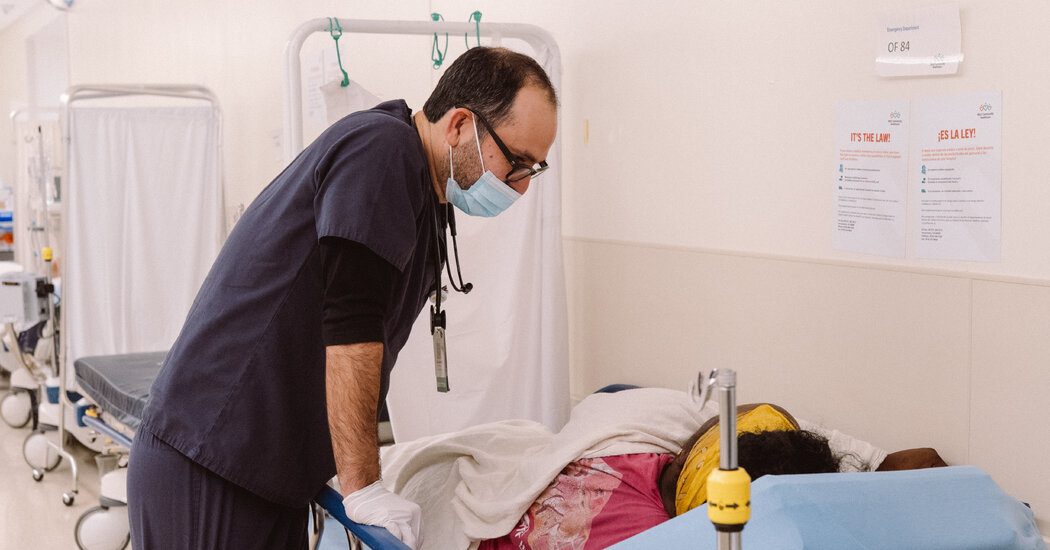
It’s an extraordinarily difficult time to find a job in America, as employers grapple with a hiring crisis due to the pandemic and are hesitant to invest in new staff while policy changes come fast and furious from Washington.
But the picture is even worse without one sector: healthcare.
The industry and related occupations in the social assistance category added 693,000 jobs last year. Without them, the economy would have lost 570,000 jobs as businesses and professional services, retail, the federal government and manufacturing contracted.
The insatiable growth of healthcare is good news for people making it into the workforce, offering mobility and opportunities for advancement. That’s why nurses in New York City won pay raises and job protections last month after a weeks-long strike that forced hospitals to spend heavily on traveling staff, and why health care jobs offer signing bonuses that are unusual for most professions.
But it also highlights the slack in the rest of the labor market, where new hiring has stagnated. As the unemployment rate has risen, most job postings have quickly attracted qualified candidates – except for medical positions, which are taking longer to fill, said Raj Namboothiry, senior vice president for the United States at Manpower, a staffing firm.
“Healthcare has been making steady progress while the rest of the sectors are on pause,” Mr Namboothiry said. “This has become America’s most reliable job engine. Health care is keeping the lights on.”
Some of the growth is due to catch-up hiring for a sector that took longer than most to recover from the pandemic after frontline workers burned out and left the field. But the faster pace could be maintained as recent baby boomers retire and require more care, from hospitals to home care workers.
“Healthcare is currently excelling at fulfilling its natural purpose,” said Kosali Simon, a health economist at Indiana University-Bloomington. “What’s not happening is that other sectors aren’t doing the same thing. Healthcare isn’t as discretionary – it needs to grow.”
An ever stronger anchor
The growth of the healthcare industry is not new. Driven by changes in consumer spending and expanded access to insurance, as well as an aging population, the health and social assistance sector’s share of total employment rose from 8.3 percent of total employment in 1990 to nearly 15 percent today, compared with about 8 percent in manufacturing. The dominance of healthcare only increases during recessions, as people need to go to the doctor even when they put off buying a new car.
The sector’s expansion has been good for places that have become medical centers, particularly outside major metropolitan areas that have lost large industrial employers.
Take Montour County, Pennsylvania, which has the highest concentration of healthcare jobs in the country. More than half of the roughly 18,000 workers are employed in the industry, mostly at the Danville headquarters of Geisinger Health, a hospital system that has bought up smaller clinics across the state. The company is in the middle of an $880 million construction project to create more operating rooms and private beds.
Jennifer Wakeman, economic development director for the five-county region that includes Danville, said the industry has grown fairly consistently in a place without many other major economic drivers.
“If you think about economic development statistics 101, it’s about job creation and capital investment. They do both,” Ms. Wakeman said. “It’s a huge benefit to the community to have this type of player literally on our doorstep.”
Or check out Morgantown, W.Va. where job losses in steel production and coal mining were more than offset by the growth of WVU Medicine, which launched its own insurance plan in 2021 and employs more than 26,000 people. Telehealth services, which exploded during the pandemic, mean doctors can serve more people in the rural, sicker-than-average state, which expanded its Medicaid program in 2014.
The institution is strong enough that when Mylan Pharmaceuticals, a generic drug maker, closed a 1,500-employee factory in 2021, WVU Medicine took it over and converted it into a health sciences incubator.
“For most communities, the loss of such a large employer would have been devastating,” said Russ Rogerson, president of the Morgantown Area Partnership. “But in Morgantown and Monongalia County it really didn’t have much of a negative impact because the growth of our health care industry absorbed it.”
It’s not just small towns that benefit from this. Las Vegas recognized the cyclical nature of its hotel industry and committed to investing in health care, including a new medical school, during the 2009 recession. Since 2015, employment in this sector has increased 56 percent citywide, compared to 23 percent overall. The foundation stone for a children’s hospital is to be laid this year.
Shani Coleman, director of community and economic development for Clark County, which includes Las Vegas, sees the city’s casinos and hospitals as complementary. Patients can come from out of town to have a good time before their medical procedure. And while employment in the entertainment industry has barely recovered post-pandemic, workers are naturally transitioning to bedside roles.
“As a community, our hospitality industry provides really good customer service,” Ms. Coleman said. “If you can embrace that and combine it with health care, it creates an opportunity where you get a high level of care.”
Always looking for help
It is not clear whether the supply of workers can keep pace with the ever-growing need for care. Although artificial intelligence may save administrative positions in billing and marketing, bedside jobs will not be replaced any time soon.
Richard Merchant is executive director of the Health Workforce Collaborative of New York, which coordinates employers and training programs to connect people with in-demand skills, especially as the existing medical workforce nears retirement.
“It’s true that the health care industry is doing well,” Mr. Merchant said. “It would have to be much stronger and the distribution would have to be much better than it actually is to keep up with the increasing job openings.”
Filling these vacancies has become more difficult in the past year, Merchant said, because 35 percent of medical professionals in New York state are immigrants. The Trump administration has narrowed entry options for workers from abroad, including doctors on H-1B visas who are particularly important to rural clinics, as well as millions of people with temporary protected status, such as Haitians who have attended nursing homes and rehabilitation facilities.
Their absence quickly became noticeable: A 25 percent increase in immigration flows would save 5,000 lives in the United States each year, according to a recent paper published by the National Bureau of Economic Research.
Other changes by the Trump administration could also limit the supply of new medical professionals, such as its plan to cap student loans for nursing graduates at $100,000.
Olivia Jackson gave up her career as a chef a few years ago and was looking for better pay and more regular hours. After being laid off from an agency job in Washington state last summer, knowing the high demand for nurses, she enrolled in a community college to complete nursing school requirements. She worries about whether she will be able to borrow enough to afford it.
“I want to be a nurse, but I’m not sure I’ll have the resources to do it,” Ms. Jackson said. “I’m currently unemployed. I have no money to live on and no tuition fees.”
Nursing offers the highest earning potential without going to medical school, but there are other options as well — and a high demand for workers with more specific skills, such as operating an EKG machine, sterilizing surgical equipment and analyzing lab samples. Cengage, a company that offers short-term online training modules, said sales of medical courses are increasing 20 to 40 percent annually.
One of the most in-demand jobs requires little education but pays about the same as fast food jobs: housekeeping. Medicaid and Medicare pay most of their salaries, but rates are low and could get even lower after President Trump signed a law last year limiting federal health care spending.
“If Medicaid only pays $16 an hour and that amount is below what the market should pay, you’re going to run into some of these problems,” said Gopi Shah Goda, director of the Retirement Security Project at the Brookings Institution. “That’s just another way of saying there just aren’t enough workers at prevailing wages.”
A leaky bucket
The other challenge is ensuring that once people get the training they need, they stay to do their jobs.
The extreme stress caused by the pandemic forced hundreds of thousands of medical professionals to flee their homes in 2020 and 2021. Even after the crisis ended, conditions such as staff shortages and violence against service providers pushed many people out of the profession. According to job review website Glassdoor, healthcare workers judge their employers more harshly than workers in other industries.
Olga Yakusheva, an economist at the Johns Hopkins School of Nursing, estimates that one in three licensed nurses no longer work in the profession.
“We spent all this time just training the nurses and they can’t stay and work,” Ms. Yakusheva said. “We don’t have a shortage of nurses, but there is a shortage of open positions that nurses would like to fill.”
Lloyd Stanley attended nursing school in his late 30s after working as a paramedic for several years. He spent a few years in urgent care centers and nursing facilities, then began working for nurse staffing agencies to have more flexibility in caring for his own mother, who has dementia. During the pandemic, he said, management made financially driven decisions that impacted patient care, such as a lack of adequate supplies or staffing.
Mr. Stanley has no plans to give up nursing. Although gig work can be frustrating, he loves the fundamental task of helping people. But he understands why people become disillusioned and give up.
“They work in facilities that are inherently frustrating,” he said. “Nurses want to take care of people. I feel like nature is being taken advantage of a little bit. It can be pretty demoralizing.”